
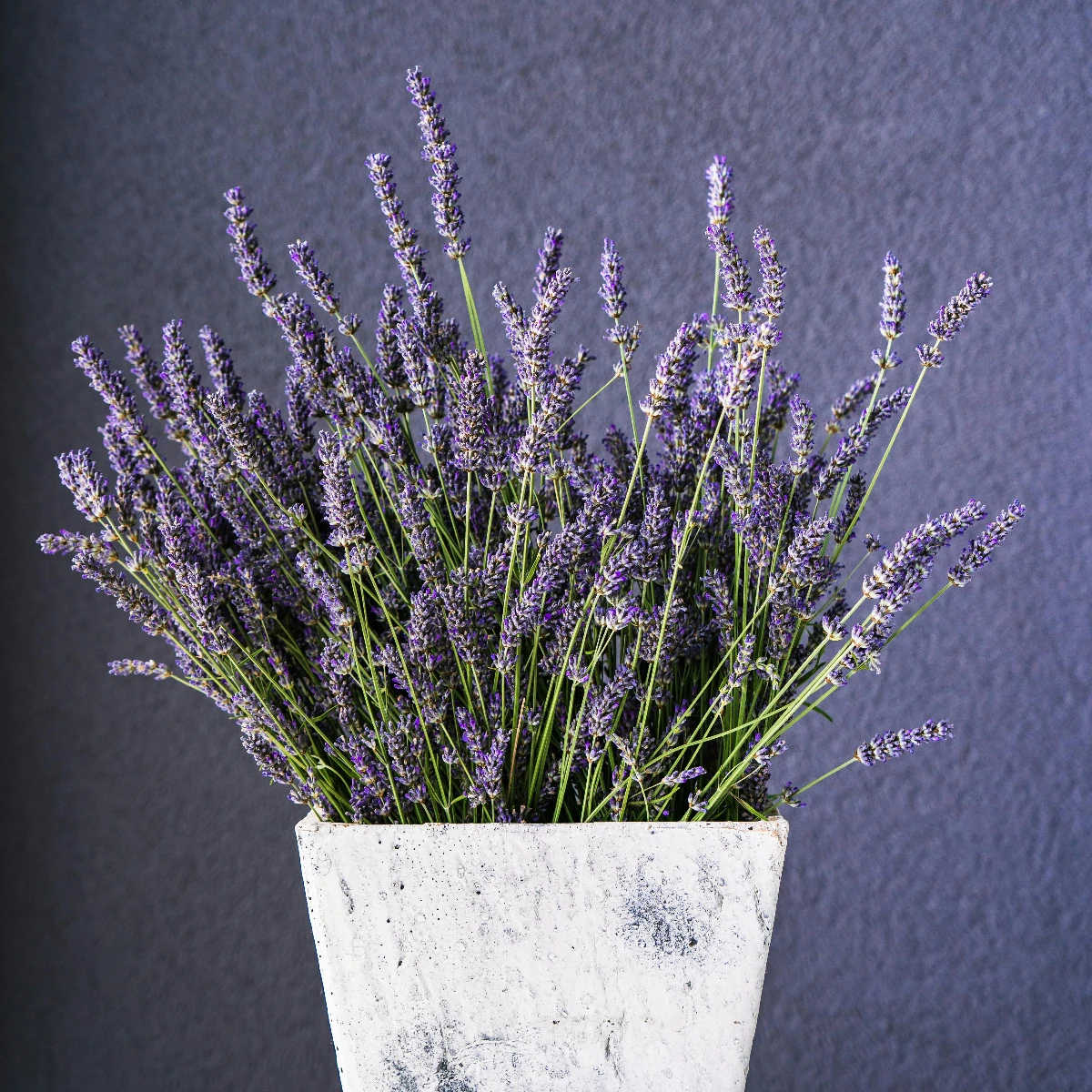
Lavender is a sun-loving Mediterranean herb with fragrant purple flowers and silver-green foliage. It's rewarding to grow but has specific requirements: maximum sunlight, excellent drainage, and a lean soil. Meeting those three conditions almost guarantees success; ignoring any one of them is the most common reason lavender dies indoors.
Quick Care Reference
| Care Aspect | Requirement | Frequency |
|---|---|---|
| Light | Full sun; minimum 6 hours direct sunlight | Constant |
| Watering | When top 2 inches of soil are dry | Every 1–2 weeks (summer), every 3–4 weeks (winter) |
| Soil | Well-draining, slightly alkaline (pH 6.5–7.5), lean | Replace or amend at repotting |
| Fertilizing | Low-nitrogen, slow-release | Once in early spring |
| Pruning | One-third after flowering, light shaping in spring | 1–2 times per year |
| Repotting | When root-bound, into slightly larger pot | Every 2–3 years |
| Humidity | Low; under 50% | Maintain year-round |
Watering
Lavender is drought-tolerant once established but not invincible. Water when the top 2 inches of soil are dry; roughly every 1–2 weeks in summer and every 3–4 weeks in winter. The two watering mistakes that kill lavender are: (1) watering on a schedule rather than checking soil moisture, and (2) letting water sit at the base, which causes root and crown rot. Always water at the base, never on the foliage.
Light Requirements
Lavender requires a minimum of 6 hours of direct sunlight daily; and more is better. A south-facing window is essential for indoor growing. Without full sun, lavender becomes leggy, produces few flowers, and is susceptible to fungal disease. If your home lacks a suitable sunny window, lavender is better grown outdoors or on a sunny balcony.
Humidity & Temperature
Lavender comes from the dry Mediterranean and struggles in high humidity. Above 60% humidity, lavender is prone to botrytis (gray mold) and root rot. Provide excellent air circulation, avoid misting, and keep away from humid rooms. In humid climates, outdoor lavender needs excellent site drainage to prevent crown rot.
Fertilizing
Lavender prefers lean soil and does not need heavy fertilizing. In poor soils, apply a low-nitrogen, slow-release fertilizer or bone meal in early spring. Avoid high-nitrogen fertilizers, which produce lush green growth at the expense of flowers and fragrance, and make the plant more susceptible to disease.
Propagation
Lavender is propagated most reliably from stem cuttings. Seeds are slow and variable; the vegetatively propagated varieties won't come true from seed.
Softwood cuttings (spring–early summer): Take 3–4 inch cuttings from new non-flowering growth. Strip lower leaves, dip in rooting hormone, and insert in moist perlite or propagation mix. Keep humid and in bright indirect light. Roots form in 3–6 weeks.
Semi-hardwood cuttings (late summer): Take 4–6 inch cuttings from current season's growth that has begun to firm up. Process as softwood cuttings but roots form more slowly (6–10 weeks).
Layering: Bend a low branch to the ground, bury a section in soil while leaving the tip exposed, and pin down. Roots form in 2–3 months. Separate from the parent plant once rooted.
Popular Varieties
Lavandula angustifolia (English Lavender)
Also known as: True Lavender, Common Lavender
The hardiest and most fragrant lavender. Compact habit, narrow gray-green leaves, classic purple-blue flowers. Best for cold climates. Most culinary lavender is this species.
Hardiest lavender variety; tolerates frost down to -20°F (-29°C) in well-drained soil.
Lavandula stoechas (French Lavender)
Also known as: Topped Lavender, Spanish Lavender
Distinguished by rabbit-ear petals atop the flower head. Blooms earlier and more continuously than English lavender. Less cold-hardy but more heat and humidity tolerant.
Blooms from spring to fall in mild climates; deadhead regularly to extend the season.
Lavandula x intermedia (Lavandin)
Also known as: Dutch Lavender, Hybrid Lavender
A hybrid between English and Portuguese lavender. Larger plant with more oil production. Popular for dried flowers and sachets. Less fragrant than English lavender for culinary use.
Most lavender essential oil comes from lavandin hybrids; they produce more oil than angustifolia.
Seasonal Care Calendar
Spring
March – May
- Light pruning to shape and remove winter damage
- Apply slow-release fertilizer if needed
- Begin regular watering as growth resumes
- Watch for aphids on new growth
Summer
June – August
- Harvest flowers when one-third of buds are open for maximum fragrance
- Prune by one-third after first flowering to encourage second bloom
- Water at base only; never on foliage
- Ensure excellent air circulation
Fall
September – November
- Take semi-hardwood cuttings for propagation
- Reduce watering as temperatures drop
- Do not prune hard; wait until spring
- Mulch base in frost-prone areas
Winter
December – February
- Water sparingly; only when soil is quite dry
- Bring tender varieties indoors before hard frost
- Ensure maximum light; move to brightest window
- No fertilizing
Troubleshooting
Woody, leggy growth with few flowers
Why it happens: Insufficient pruning over multiple years causes lavender to become woodier from the base, with sparse growth at the tips and fewer flowers.
What to do: Prune by one-third annually after flowering. Never cut into the old woody brown stems; lavender does not regenerate from old wood like many other shrubs. Replace severely woody plants that no longer regenerate.
Ask the AI about this →Gray mold (botrytis) on flowers or stems
Why it happens: High humidity, poor air circulation, or overwatering. Botrytis thrives in damp, still conditions.
What to do: Remove all affected growth immediately. Improve air circulation. Reduce humidity if growing indoors. Avoid wetting foliage when watering. Treat with a copper-based or neem fungicide if needed.
Learn more: Powdery Mildew on Houseplants → Ask the AI about this →Yellowing leaves and wilting despite adequate water
Why it happens: Root rot from poor drainage. Lavender sitting in wet soil develops crown and root rot quickly.
What to do: Check the roots; remove from pot and inspect. Trim any black, mushy roots. Repot into fresh, gritty mix with added perlite. Ensure the pot has drainage holes and that the drainage plate is emptied after watering. Do not water again until the soil is completely dry.
Learn more: Am I Overwatering My Plant? → Ask the AI about this →No flowers despite healthy-looking plant
Why it happens: Insufficient sunlight (most common), too much nitrogen fertilizer, or the plant is too young (first-year lavender rarely flowers well).
What to do: Move to maximum available sunlight. Switch to a low-nitrogen or phosphorus-heavy fertilizer to encourage flowering. If the plant is under 18 months old, be patient; lavender establishes roots before committing to flowers.
Ask the AI about this →Not sure what's wrong?
Premium includes AI photo diagnosis, then walks you through the fix and checks back in until it's better.
See Premium →Track your Lavender with PlantCareAI
Add your Lavender and get a watering schedule tuned to this week's weather. Free for up to 3 plants.
Add your Lavender