
Best Grow Lights for Indoor Plants: A Practical Guide
By Ellen Hermance · PlantCareAI Editorial
Not all homes get enough natural light for houseplants, and even bright rooms can leave plants struggling through short winter days. A good grow light solves this, but choosing one can feel overwhelming with so many options. This guide breaks down the types, key specs, and how to use them effectively so your plants thrive year-round.
Quick Answer: For most houseplants, a full-spectrum LED panel in the 4,000 to 6,500K range is all you need. Budget 20 to 30 actual watts per square foot of shelf, hang it 6 to 18 inches above the leaves, and put it on a timer for 12 to 16 hours a day. Low-light plants like pothos want 50 to 150 PAR, medium-light plants 150 to 250, and high-light plants 250 or more. If you only need to get through a dark winter, a BR30 grow bulb in an ordinary lamp will do.
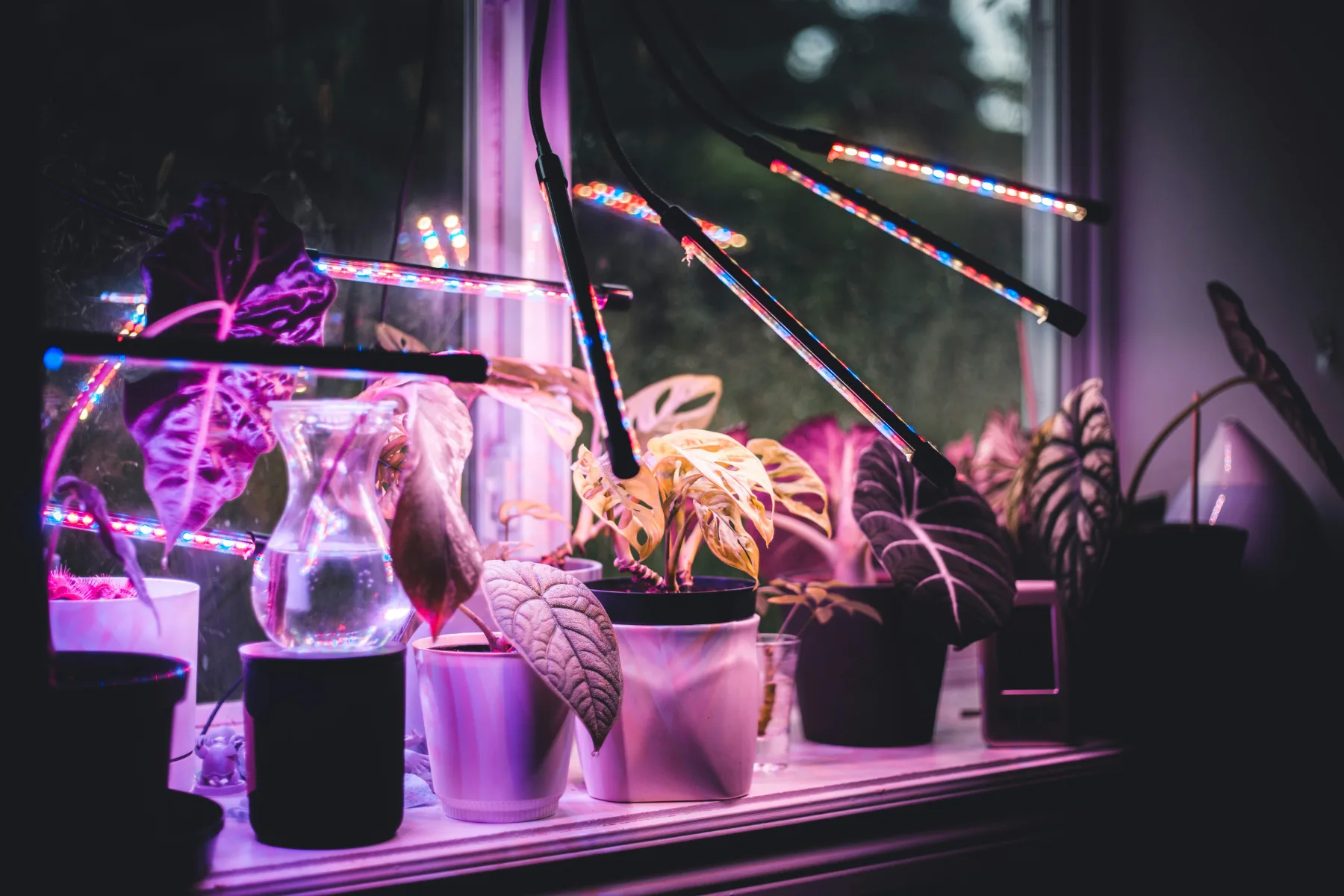
Types of Grow Lights for Indoor Plants
-
LED Grow Lights
Full-spectrum LED panels are currently the best all-around choice for most houseplant growers. They run cool, use less electricity than older technologies, and last for tens of thousands of hours. Modern LEDs cover the blue and red wavelengths plants need for both leafy growth and flowering.
What to do: Look for a full-spectrum LED rated for your coverage area. For a small shelf (2x2 ft), a 45-60W LED panel is typically sufficient. Position it 6-18 inches above the canopy depending on plant density.
-
Fluorescent and T5 Lights
T5 fluorescent tubes are a proven option for seedlings, herbs, and low-light plants. They emit a gentler light spread than LED panels, which makes them forgiving for delicate plants. They run slightly warmer and cost more to operate over time than LEDs but are widely available.
What to do: Hang T5 fixtures 2-4 inches above seedlings and 4-6 inches above established leafy plants. Replace bulbs every 12-18 months as output degrades even if the light still appears bright.
-
Light Intensity: PAR and Lumens
Plants measure usable light in PAR (Photosynthetically Active Radiation), not lumens. Lumens measure brightness for human eyes, so a grow light listing only lumens tells you little about how plants will respond. Low-light plants like pothos need 50-150 PAR; medium-light plants need 150-250 PAR; high-light plants need 250-450+ PAR.
What to do: Check product listings for PPFD (a PAR measurement at a specific distance) rather than relying on lumens alone. Reputable LED brands publish PPFD charts for their fixtures.
-
Photoperiod: How Long to Run the Light
Most houseplants do well with 12-16 hours of supplemental light per day. Running lights longer than 18 hours does not help and may stress some plants that need a dark period. Letting lights run 24/7 is a common beginner mistake.
What to do: Use an outlet timer to automate the light schedule. Set it to run 14-16 hours per day for foliage plants and 12-14 hours for plants you want to flower. Consistent timing matters more than total hours.
-
Placement and Distance
Grow lights that are too far away deliver insufficient intensity; too close, and they scorch leaves. The right distance depends on the light's wattage and the plant's light needs. High-intensity LEDs need more clearance than T5 tubes.
What to do: Start with the manufacturer's recommended distance and watch leaves for two weeks. Pale, stretching stems mean the light is too far; bleached or crispy patches mean it is too close. Adjust by 2 inches at a time.
-
Supplemental vs. Full Replacement
Grow lights work best as a supplement to natural light, boosting a dim north-facing room or extending short winter days. In rooms with zero natural light, plants can survive but often grow slowly. Combining a grow light with the best available window position gives the best results.
What to do: Position grow lights to supplement the weakest part of your plant's light day. In winter, run the light in the afternoon when natural light drops. In summer, you may be able to reduce light hours as days lengthen.
Grow light types compared
Full-spectrum LED wins on almost every count. The others still make sense when up-front cost decides it or when you are lighting a single plant.
| Light type | Power draw | Lifespan | Best for |
|---|---|---|---|
| Full-spectrum LED panel | Low | 25,000 to 50,000 hours | Shelves and collections |
| LED grow bulb (BR30) | Very low | 25,000 hours | One or two plants in a normal lamp |
| T5 fluorescent tube | Medium | 12 to 18 months | Seedlings, herbs, and cuttings |
| Compact fluorescent (CFL) | Medium | 8,000 hours | Small low-light plants |
| Metal halide (HID) | High | 10,000 hours | Serious growing, not a living room |
Frequently Asked Questions
- How many hours a day should a grow light run?
- Twelve to 16 hours for foliage plants, and 12 to 14 if you want flowering. Running past 18 hours speeds nothing up and stresses species that need a dark period to complete their cycle. An outlet timer costs little and solves the problem permanently, and a consistent schedule matters more than the total hours.
- Will an ordinary LED bulb work for plants?
- It helps a low-light plant survive if you put it close, but it will not make it grow. A household bulb is built to make a room look good, not to deliver intensity at a foot away. The difference is not really the color of the light but how much of it reaches the leaf: an ordinary bulb delivers a fraction of the PPFD of a grow bulb drawing the same watts.
- How far should the light be from the plants?
- Six to 18 inches depending on wattage, then let the plant correct you. Start at the manufacturer's distance and watch for two weeks: long pale stems with widely spaced leaves mean it is too far away, while bleached, crispy, or downward-curling patches mean it is too close. Adjust two inches at a time.
- Are purple grow lights better than white ones?
- No. Purple just means the panel combines red and blue diodes, the wavelengths photosynthesis uses most. A white full-spectrum panel includes those same wavelengths plus the rest, performs about the same, and has one practical advantage: under purple light you cannot see the true color of the leaves, which is the first sign that something is wrong.
- Can a grow light replace a window entirely?
- Yes, if the intensity and the hours are there. Plenty of growers keep whole collections in windowless rooms on LED panels and timers. What does not work is a weak light or too few hours: the plant survives, stretches, and stops putting out new leaves. If you are replacing daylight rather than topping it up, run 14 to 16 hours and move the panel closer.
- How much electricity does a grow light use?
- Not much. A 45W LED panel running 14 hours a day uses about 0.63 kWh daily, roughly 19 kWh a month, or around three dollars at typical US rates. Fluorescent tubes and HID fixtures use considerably more for the same usable light, which is where an LED earns back its higher purchase price.
The Bottom Line on Grow Lights
For most houseplants, a full-spectrum LED panel or bulb in the 4,000-6,500K range is all you need. Start simple: a BR30 grow bulb in a standard lamp works for low-light tolerant plants. If you are growing herbs, succulents, or anything that needs bright direct light, step up to a dedicated LED panel with a timer. Consistency matters more than wattage.
Get Personalized Plant Care Advice
PlantCareAI uses your location and local weather to give you advice tailored to your exact situation. No signup required to try.
Try the AI Plant Doctor