
Humidity for Tropical Houseplants: What They Need and How to Provide It
By Ellen Hermance · PlantCareAI Editorial
Most popular tropical houseplants, including calatheas, ferns, orchids, and alocasias, evolved in rainforests where humidity rarely drops below 60%. The average home sits at 30-50%, which is survivable for most plants but below their happy range. Brown leaf tips, crispy edges, and curling leaves are usually the first signs. This guide explains exactly what humidity levels different plants need and the most effective ways to raise it.
Quick Answer: Most tropical houseplants want 50 to 60% relative humidity, and the fussiest ones (calathea, fittonia, ferns, alocasia) prefer 60% or more. The average home sits between 30 and 50%, and drops further in winter with the heat running. Measure with a digital hygrometer: below 40%, an ultrasonic humidifier near the plants is the only thing that raises humidity consistently. Grouping plants and pebble trays help a little. Misting does not raise room humidity at all.
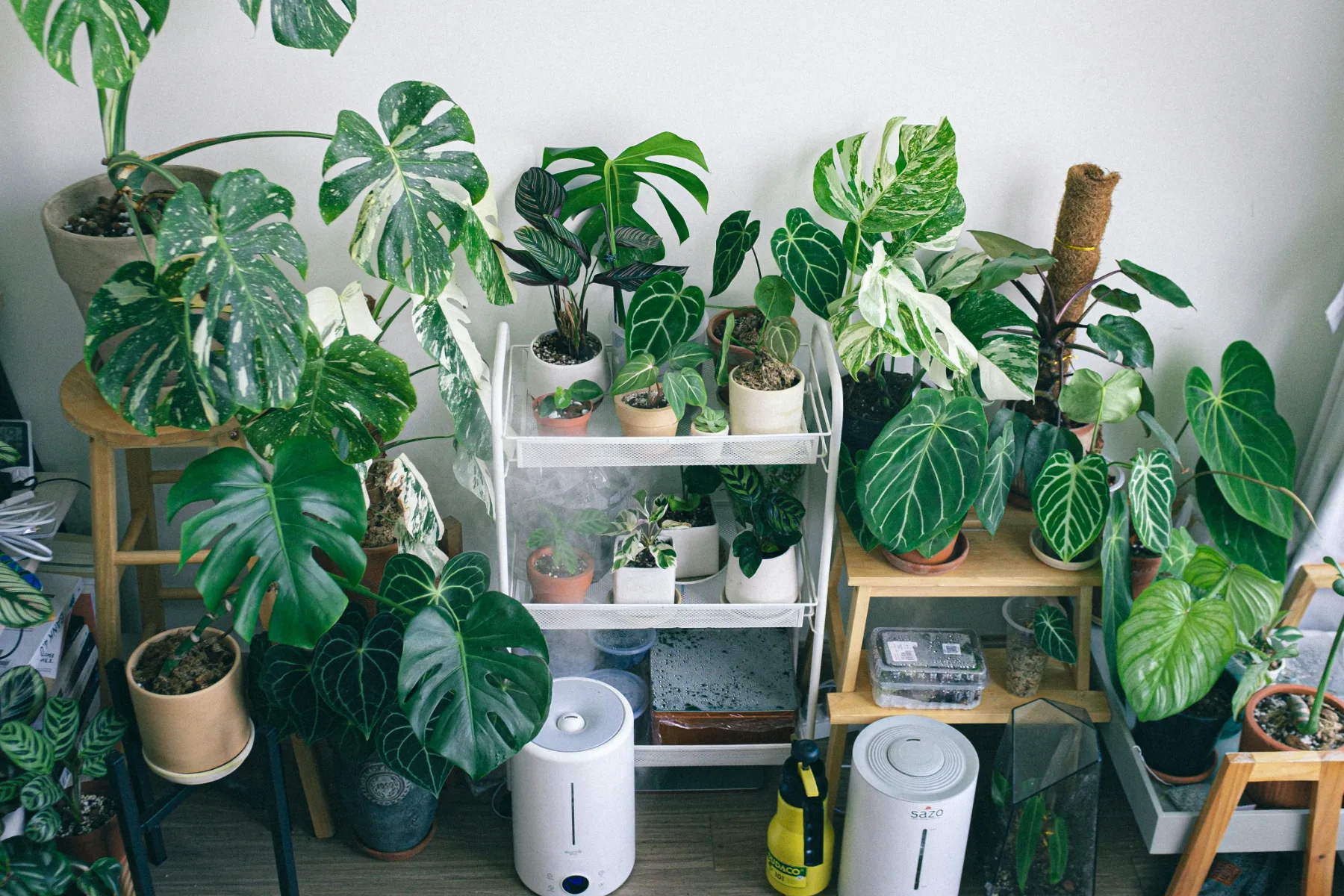
How to Increase Humidity for Indoor Plants
-
Why Humidity Matters for Tropical Plants
Plants lose water through their leaves constantly in a process called transpiration. In dry air, they lose water faster than roots can replace it, causing stress even when the soil is moist. Tropical species evolved with high-humidity air that slows this moisture loss, which is why they struggle in dry indoor environments.
What to do: Measure your home's humidity with an inexpensive digital hygrometer (under $15). Place it near your plants and check readings over a few days. Readings below 40% warrant action for most tropicals.
-
Which Plants Are Most Sensitive
Calatheas, fittonias, ferns, orchids, alocasias, and anthuriums are the most demanding, wanting 60-70% or higher. Pothos, philodendrons, and monsteras adapt reasonably well to 40-50%. Cacti and succulents prefer dry air and should not be grouped with humidity-loving tropicals.
What to do: Group your most demanding plants together in your most humid room (often the bathroom or kitchen). Less sensitive plants can go elsewhere. This simple sorting reduces the effort needed to satisfy everyone.
-
Humidifiers: The Most Effective Solution
A cool-mist ultrasonic humidifier placed near your plant collection is the single most effective way to raise ambient humidity. Unlike most other methods, it can reliably raise room humidity by 15-25 percentage points. Warm-mist humidifiers work equally well but use more energy.
What to do: Choose a humidifier with a tank large enough that you are not refilling it daily, with 2-3 liters a reasonable minimum. Clean it weekly to prevent mold and mineral buildup. Position it 2-3 feet from plants to avoid water droplets pooling on leaves.
-
Pebble Trays
A tray filled with pebbles and water placed under or near your plants creates a small zone of elevated humidity as the water evaporates. It is less effective than a humidifier but costs nothing and requires no electricity. The improvement is modest, typically 5 to 10 percentage points directly around the tray.
What to do: Fill a waterproof tray with decorative pebbles or gravel, add water to just below the top of the pebbles, and set the plant pot on top. The pot base should sit above the water line, not submerged. Refill as water evaporates.
-
Plant Grouping
Plants release moisture through transpiration, so grouping several together raises the local humidity around all of them. A cluster of 5-10 plants creates a noticeably more humid microclimate than individual pots spread around a room.
What to do: Arrange humidity-loving plants close together in a single display area rather than scattering them. Combine this with a pebble tray underneath for added effect. Avoid grouping plants that need very different light levels.
-
Misting: What It Actually Does
Misting is popular but often misunderstood. It temporarily raises humidity directly on and around leaves for 20-30 minutes before the water evaporates. It does not meaningfully raise ambient room humidity. Misting is also risky, because water sitting on leaves overnight encourages fungal disease.
What to do: If you do mist, do it in the morning so leaves dry completely before nightfall. Use filtered water to avoid mineral spots on decorative leaves. For plants like calatheas and fittonia that need consistent high humidity, a humidifier is far more reliable than misting.
How much each method actually raises humidity
The increases are approximate and depend on room size and airflow. The ranking does not change.
| Method | How much it raises humidity | Effort | Cost |
|---|---|---|---|
| Ultrasonic humidifier | 15 to 25 points | Refill and clean weekly | Moderate |
| Glass cabinet or cloche | 20 to 40 points | Vent occasionally | High |
| Move the plant to the bathroom | 10 to 20 points | One time | Free |
| Group plants together | 5 to 10 points | One time | Free |
| Pebble tray | 3 to 5 points, very local | Refill weekly | Low |
| Misting | Nothing lasting, 20 to 30 minutes | Daily | Free |
Frequently Asked Questions
- What is the ideal humidity for houseplants?
- Between 50 and 60% suits almost every tropical houseplant. The demanding ones, calathea, fittonia, fern, and alocasia, prefer 60 to 70%. Cacti, succulents, snake plants, and ZZ plants are perfectly happy below 40%, so not everything in the house needs the same treatment.
- Does misting actually raise humidity?
- Barely. Misted water evaporates in 20 to 30 minutes and returns the air to where it started, so you would have to mist every half hour to hold any gain. Wet leaves overnight also invite fungal spotting. If you mist anyway, do it in the morning and use filtered water. Air plants are the real exception, since they absorb water through their leaves.
- How do I know my plant needs more humidity?
- The signature is brown, dry leaf tips, sometimes with a yellow border, along with crispy edges and leaves curling inward while the soil is still moist. If instead the whole plant droops and the soil is dry, that is underwatering. And if only the margins of older leaves scorch, it is usually salt buildup from tap water or fertilizer.
- Can a humidifier damage my home or my plants?
- It can, if you hold it above 70% for long stretches. That level condenses on windows and cold walls, and with poor airflow you get mold on the walls and fungal spotting on leaves. Stay between 50 and 60%, let air circulate, and clean the tank weekly, since a dirty humidifier aerosolizes whatever is growing in it.
- Do houseplants raise the humidity in a house?
- They do, but far less than people assume. A cluster of 5 to 10 plants creates a noticeably more humid microclimate in that corner, which is the real reason to group them. Raising a whole house with plants would take a quantity no home actually has.
- Which houseplants do not need high humidity?
- Snake plant, ZZ plant, pothos, cast iron plant, cacti, and nearly all succulents do fine at the 30 to 40% of an ordinary house. If your home runs dry and you would rather not buy a humidifier, choosing from that list settles the question once instead of fighting it every winter.
The Bottom Line on Humidity
Most tropical houseplants thrive at 50-60% relative humidity. If your home runs dry in winter, a small ultrasonic humidifier near your plant collection is the most effective solution. Grouping plants together and using pebble trays help at the margins. Misting does very little and can encourage fungal issues, so skip it.
Get Personalized Plant Care Advice
PlantCareAI uses your location and local weather to give you advice tailored to your exact situation. No signup required to try.
Try the AI Plant Doctor