
Calathea Care Guide
Calathea spp. (now reclassified as Goeppertia)
Also known as Peacock Plant, Rattlesnake Plant
By Ellen Hermance · PlantCareAI Editorial
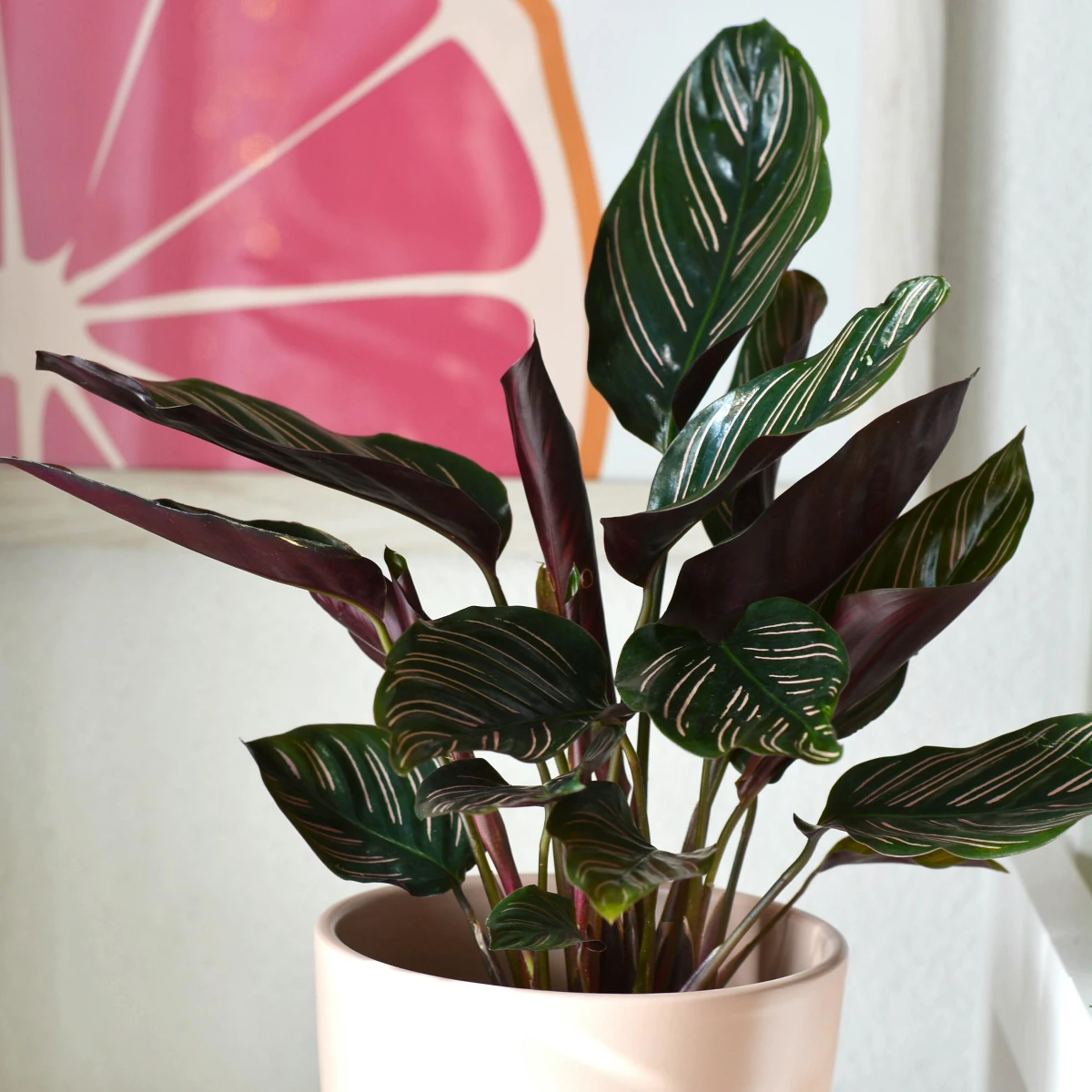
Calatheas are stunning tropical foliage plants known for their intricately patterned, colorfully painted leaves. Native to the rainforest floors of Central and South America, they belong to the prayer plant family (Marantaceae) and share the characteristic habit of folding their leaves upward at night; a phenomenon called nyctinasty. While calatheas have a reputation for being finicky, understanding their need for humidity, consistent moisture, and indirect light makes them very manageable.
Quick Care Reference
| Care Aspect | Requirement | Frequency |
|---|---|---|
| Watering | When top 1″ dry, use filtered water | Every 5-7 days (summer), 10-14 days (winter) |
| Light | Medium indirect (no direct sun) | Consistent, avoid moving often |
| Humidity | 60%+ ideal | Run humidifier daily or use pebble tray |
| Fertilizing | Balanced liquid, half strength | Monthly (spring-fall) |
| Temperature | 65-80°F (18-27°C) | Avoid cold drafts year-round |
Watering
Calatheas prefer consistently moist; but never soggy; soil. Water when the top inch of soil feels dry to the touch, which typically means every 5-7 days in the growing season and every 10-14 days in winter. Use room-temperature filtered, distilled, or rainwater whenever possible. Calatheas are notoriously sensitive to chemicals in tap water: chlorine, fluoride, and dissolved minerals can cause brown leaf tips and edges over time. If you must use tap water, let it sit uncovered overnight so chlorine can dissipate (though this doesn't remove fluoride). When watering, pour slowly and evenly over the entire soil surface until water drains from the bottom. Empty the saucer after 15 minutes; calatheas hate sitting in standing water as much as they hate drying out completely. Both extremes cause leaf curling and browning. Consistency is key: erratic watering (bone-dry followed by a drench) stresses the plant more than either condition alone.
Light Requirements
Calatheas evolved on the rainforest floor beneath a dense canopy, so they thrive in medium to bright indirect light. They are one of the few houseplants that genuinely does well in lower light conditions; a north-facing window or a spot several feet from an east-facing window is often perfect. Direct sunlight is their enemy: even an hour of direct afternoon sun can bleach their patterns, scorch leaf edges, and cause colors to fade. The distinctive leaf markings actually look their most vibrant in moderate indirect light. If a calathea's patterns are fading or leaves are curling during the day (beyond normal nyctinasty), the light is likely too intense. Conversely, in very low light, new leaves may be smaller and growth will slow significantly. Calatheas are excellent choices for rooms that other plants find too dim; offices with fluorescent lighting, shaded rooms, or interior spaces away from windows. If supplementing with grow lights, position them further from the plant than you would for sun-loving species.
Humidity & Temperature
Humidity is the make-or-break factor for calathea success. These rainforest natives need consistently high humidity; ideally 60% or above. In most homes, especially during winter when heating dries the air, humidity typically sits around 30-40%, which is far too low. Brown, crispy leaf edges are the telltale sign of insufficient humidity. The most effective solution is a humidifier placed near (but not directly aimed at) your calatheas. Pebble trays provide a small localized boost: fill a tray with pebbles, add water to just below the top of the pebbles, and set the pot on top. Grouping tropical plants together also raises the ambient humidity through collective transpiration. Misting is debated; it provides a brief humidity boost that evaporates within minutes, and can promote fungal issues if water sits on leaves. If you do mist, use distilled water to avoid mineral spots. Bathrooms with windows can be excellent calathea locations due to naturally higher humidity. Temperature-wise, keep calatheas between 65-80°F (18-27°C). They suffer below 60°F and can be permanently damaged by cold drafts from windows, doors, or air conditioning.
Fertilizing
Calatheas are moderate feeders. During the growing season (spring through early fall), feed monthly with a balanced liquid fertilizer diluted to half strength. A general-purpose 10-10-10 or 20-20-20 formula works well. Avoid fertilizers with high fluoride content, as calatheas are especially sensitive to fluoride toxicity (which causes brown leaf tips similar to low humidity damage). Stop fertilizing completely from November through February when growth slows. Over-fertilizing causes salt buildup in the soil, which damages delicate calathea roots and can cause leaf burn. If you see white crusty deposits on the soil surface, flush the pot thoroughly with plenty of water to wash out accumulated salts. For a gentler approach, worm castings mixed into the soil during repotting provide slow-release nutrition without the risk of chemical burn. Fish emulsion is another organic option, though it has a strong smell. Always water the soil before applying liquid fertilizer to protect roots from concentrated nutrients.
Propagation
Unlike many houseplants, calatheas cannot be propagated from leaf or stem cuttings; they must be propagated by division. This makes propagation a bit less prolific than with plants like pothos or succulents, but it's reliable and straightforward. The best time to divide is during repotting in spring, when the plant is about to enter its most active growth phase and will recover quickly.
Root Division
- Water the calathea thoroughly 24 hours before dividing; this hydrates roots and makes the soil easier to work with.
- Remove the plant from its pot and gently shake or rinse off excess soil to expose the root system.
- Identify natural divisions; calatheas grow in clumps, and you'll see separate sections with their own stems and root clusters.
- Gently pull or cut the sections apart, ensuring each division has at least 2-3 stems and a healthy portion of roots.
- Pot each division in a fresh, well-draining potting mix at the same depth it was growing before.
- Water lightly, place in warm, humid conditions with indirect light, and avoid fertilizing for 4-6 weeks while roots establish.
Water Propagation (for rooted divisions)
- If a division has minimal roots, place it in a jar of filtered water with the base submerged.
- Keep in warm, bright indirect light and change the water every 3-4 days.
- Once new roots reach 2-3 inches long (typically 2-4 weeks), transfer to soil.
- Maintain high humidity around the newly potted division for the first few weeks.
Popular Varieties
Calathea orbifolia
Also known as: Goeppertia orbifolia
One of the most coveted calatheas, featuring large, round leaves (up to 12 inches wide) with elegant silver-green and dark green stripes. The subtle, sophisticated pattern sets it apart from flashier calatheas. Grows up to 2-3 feet tall and wide.
More tolerant of lower humidity than some calatheas, but still prefers 50%+.
Calathea medallion
Also known as: Goeppertia veitchiana 'Medallion'
A showstopper with large, round leaves painted in dark green, light green, and cream feathered patterns on top, with rich burgundy-purple undersides. When the leaves fold up at night, the purple undersides create a dramatic display.
The purple undersides are a reliable way to tell a healthy medallion; fading underside color can indicate too much light.
Calathea ornata
Also known as: Pinstripe Calathea
Dark green, glossy leaves decorated with thin pink-to-white pinstripes radiating from the central vein. The stripes start pink on young leaves and gradually turn white as the leaf matures. Compact growth habit, reaching about 2 feet tall.
Pink pinstripes are most vibrant on newer leaves and in moderate light.
Calathea lancifolia
Also known as: Rattlesnake Plant
Long, narrow, wavy-edged leaves with a distinctive pattern of alternating large and small dark green spots on a light green background. The undersides are a deep purple. One of the more forgiving calathea varieties and a great starter species for the genus.
More tolerant of lower light and humidity than most calatheas; a great starter variety.
Calathea makoyana
Also known as: Peacock Plant
Thin, almost translucent leaves with an intricate peacock-feather pattern in light green, dark green, and cream. The pattern is visible from both sides of the leaf, and the undersides have a pinkish-purple tint. A classic collector's species.
More humidity-demanding than other calatheas; aim for 65%+ to prevent crispy edges.
Seasonal Care Calendar
Spring
March – May
- Resume regular watering as new growth emerges
- Begin monthly fertilizing at half strength
- Repot or divide if root-bound; best time of year for division
- Increase humidity as heating systems shut off
Summer
June – August
- Water consistently; never let soil dry out completely
- Continue monthly fertilizing
- Monitor humidity, especially if running air conditioning
- Watch for spider mites (common in dry summer conditions)
Fall
September – November
- Gradually reduce watering frequency as growth slows
- Give last fertilizer dose in early October
- Move away from cold drafty windows
- Start running humidifier as heating season begins
Winter
December – February
- Water every 10-14 days, letting top inch dry between waterings
- Stop fertilizing completely
- Run humidifier consistently; indoor heating dramatically drops humidity
- Keep away from radiators, heating vents, and cold windows
Troubleshooting
Brown, crispy leaf edges
Why it happens: The most common calathea complaint, almost always caused by insufficient humidity. Indoor humidity below 50% will cause the thin, delicate leaf margins to dry out and turn brown. Tap water chemicals (fluoride, chlorine, and dissolved minerals) compound the problem. Cold drafts and overly dry soil are secondary causes.
What to do: Increase humidity with a humidifier (the most effective solution), pebble tray, or by grouping plants. Switch to filtered, distilled, or rainwater. Trim brown edges with sharp scissors following the leaf's natural shape; they won't heal but trimming improves appearance. Ensure you're watering before the soil dries out completely.
Learn more: Why Are My Plant Leaves Turning Brown? → Ask the AI about this →Curling leaves
Why it happens: Calathea leaves curl inward (lengthwise) when the plant is stressed. The most common causes are underwatering, low humidity, too much direct light, and temperature extremes. Note that normal nyctinasty (leaves folding up at night) is different from stress curling; nyctinasty is upward folding, while stress curling is inward rolling.
What to do: Check soil moisture first; if the top inch is dry, water thoroughly with filtered water. If the soil is moist, the issue is likely environmental: increase humidity, move away from direct light, or check for cold drafts. If leaves don't uncurl after correcting the issue within 24-48 hours, check roots for rot.
Learn more: Why Are My Plant Leaves Curling? → Ask the AI about this →Yellow leaves
Why it happens: Yellow leaves on calatheas typically indicate overwatering. When roots stay too wet for too long, they begin to rot and can no longer absorb nutrients, causing leaves to turn yellow and wilt. Cold temperatures, sudden drafts, and over-fertilizing can also cause yellowing. Some lower leaf yellowing is natural as the plant sheds its oldest leaves.
What to do: Check the soil; if it's soggy, let it dry out more between waterings. Ensure the pot has drainage holes and the soil drains well. If multiple leaves are yellowing rapidly, unpot and inspect the roots for rot (healthy roots are white and firm; rotted roots are brown and mushy). Trim dead roots, repot in fresh mix, and adjust watering.
Learn more: Why Are My Plant Leaves Turning Yellow? → Ask the AI about this →Drooping or limp leaves
Why it happens: Calathea leaves naturally rise and fall with the day-night cycle. However, persistent drooping that doesn't recover at night usually means underwatering or root rot. Severely underwatered calatheas droop dramatically as their leaves lose turgor pressure. Root rot can cause the same symptom because damaged roots can't transport water to the leaves.
What to do: If the soil is dry, water thoroughly and the leaves should perk up within a few hours. If the soil is wet and the plant is still drooping, root rot is likely. Unpot, remove any mushy brown roots, repot in fresh well-draining soil, and water more carefully going forward. Calatheas recover from underwatering much more easily than from overwatering.
Learn more: Why Are My Plant Leaves Drooping? → Ask the AI about this →Spider mites in dry air
Why it happens: See our dedicated guide for detailed identification and treatment.
What to do: Read the full guide: How to Treat Spider Mites on Houseplants
Learn more: How to Treat Spider Mites on Houseplants → Ask the AI about this →Not sure what's wrong?
Premium includes AI photo diagnosis, then walks you through the fix and checks back in until it's better.
See Premium →Track your Calathea with PlantCareAI
Add your Calathea and get a watering schedule tuned to this week's weather. Free for up to 3 plants.
Add your Calathea