
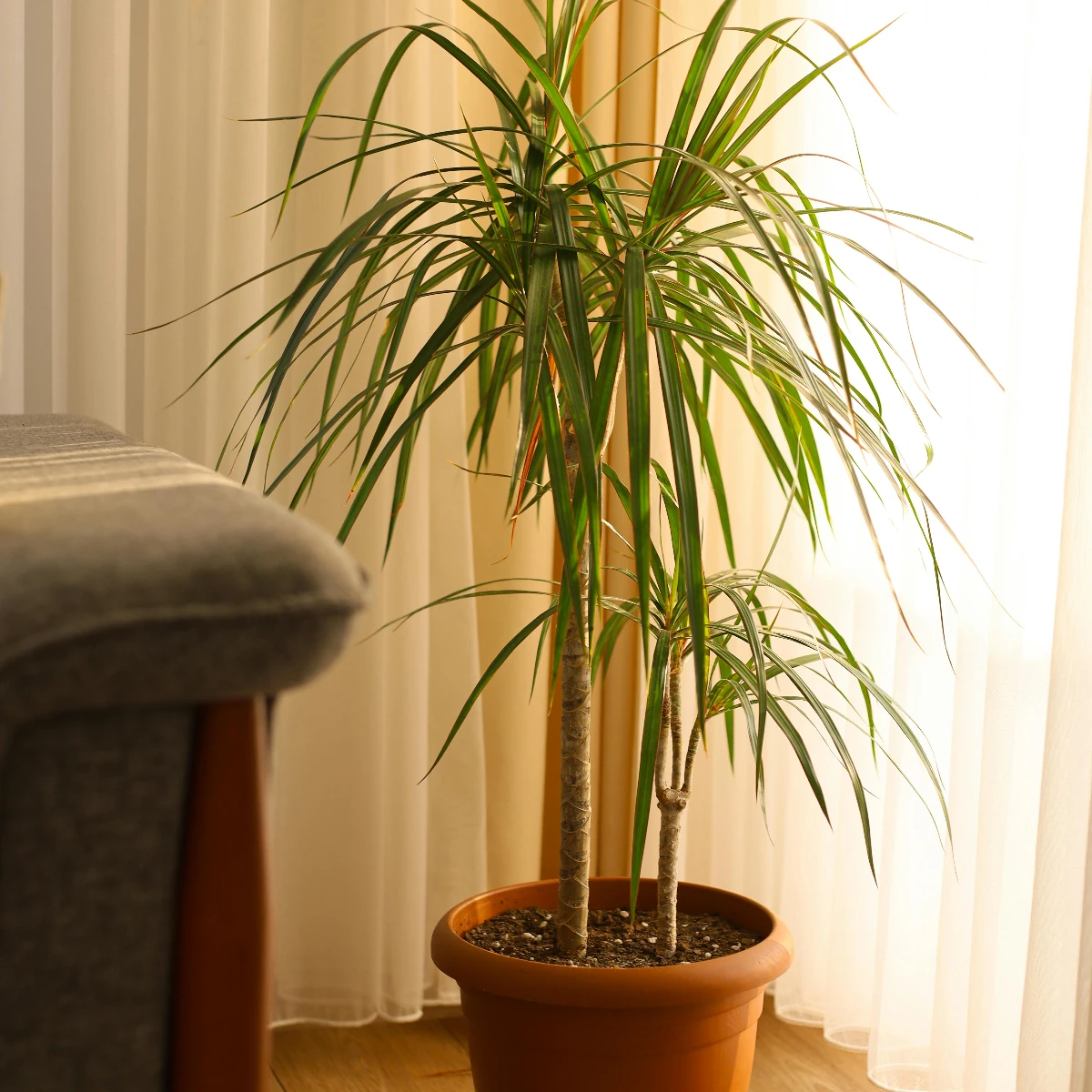
Dracaenas are one of the most forgiving houseplants you can own. With their bold, strap-like leaves in deep green, yellow-edged, or tri-color combinations, they bring a tropical, architectural quality to any room. Native to tropical Africa, Madagascar, and parts of southern Asia, dracaenas tolerate low light, infrequent watering, and dry indoor air; making them a top pick for offices, beginners, and anyone who travels.
Quick Care Reference
| Care Aspect | Requirement | Frequency |
|---|---|---|
| Watering | When top 2–3″ are dry | Every 10–21 days (less in winter) |
| Light | Low to bright indirect | 4–8 hours daily |
| Humidity | 30–50% (typical home) | No regular misting needed |
| Fertilizing | Balanced liquid, half strength | Monthly (spring–summer only) |
| Repotting | When root-bound | Every 2–3 years |
Watering
Dracaenas are drought-tolerant and prefer to dry out between waterings. Allow the top 2-3 inches of soil to dry completely before watering; in most homes this means every 10-21 days depending on light, pot size, and season. Always water thoroughly so it drains from the bottom, then tip out any standing water. Overwatering is by far the most common cause of dracaena death; soggy soil quickly leads to root rot. In winter, cut back watering to once every three weeks or when the top half of the soil is dry. Dracaenas are also sensitive to fluoride in tap water; brown leaf tips are a telltale sign. Use filtered or rainwater if possible, or leave tap water out overnight to off-gas chlorine.
Light Requirements
Dracaenas are one of the best houseplants for lower-light conditions. They thrive in medium to bright indirect light (4-6 feet from a window) but can survive in dim corners that would kill most plants. Direct sunlight scorches their leaves quickly, so avoid placing them in a south-facing window without a sheer curtain. Variegated varieties like 'Lemon Lime' and 'Tricolor' need slightly more light to retain their colorful markings; medium indirect is the minimum. In very low light, growth slows dramatically and new leaves will be smaller. A grow light on a timer can compensate during short winter days.
Humidity & Temperature
Dracaenas adapt well to average household humidity (30-50%) and don't require regular misting or a humidifier. They're well-suited to dry apartment air and offices. If your home is extremely dry in winter (below 20% humidity), occasional misting or a small pebble tray can help prevent brown leaf tips. Keep temperatures between 60-80°F (15-27°C) and away from cold drafts, heating vents, and air conditioning; sudden temperature swings cause leaf drop. They will not tolerate frost and prefer consistently warm conditions.
Fertilizing
Dracaenas are light feeders. Fertilize once a month during spring and summer with a balanced liquid fertilizer diluted to half strength. Do not fertilize in fall or winter; feeding during dormancy can cause salt buildup that burns the roots and tips the leaves brown. If your plant's lower leaves are slowly yellowing and dropping at a normal rate, this is natural shedding and does not indicate a nutrient deficiency. Over-fertilizing is far more damaging than under-fertilizing for dracaenas.
Propagation
Dracaenas propagate readily from stem or cane cuttings. This is a great way to refresh a leggy plant and create new ones at the same time. Spring is the ideal time, but cuttings root successfully year-round indoors.
Stem Tip Cutting
- Cut 4-6 inches from a healthy stem tip just below a set of leaves.
- Remove the lower leaves, leaving 2-3 leaves at the top.
- Place in a jar of water with the cut end submerged. Change water every 5 days.
- Roots appear in 3-5 weeks. Pot in well-draining mix when roots are 1-2 inches long.
Cane Cutting
- Cut the bare cane into 2-3 inch sections, each with at least one node (raised ring on the cane).
- Lay horizontally on moist potting mix, half-buried, or stand upright in a cup of water.
- Keep warm (above 65°F / 18°C) in indirect light. Shoots emerge in 4-8 weeks.
- Once a shoot has 2-3 leaves and roots are established, pot up individually.
Popular Varieties
Dracaena marginata
Also known as: Dragon Tree
Slim, arching leaves with red or purple margins on a slender, woody cane. One of the most architectural dracaenas; grows slowly into a dramatic tree form. Very drought-tolerant.
The most popular dracaena. Extremely tolerant of neglect.
Dracaena trifasciata
Also known as: Snake Plant, Sansevieria
Formerly classified as Sansevieria, now reclassified as Dracaena. Stiff, upright leaves with horizontal banding. Arguably the most indestructible houseplant; thrives on neglect and near-darkness.
If you want a separate detailed guide, see our Snake Plant care guide.
Dracaena fragrans 'Massangeana'
Also known as: Corn Plant
Broad, corn-leaf-like foliage with a bright yellow-green central stripe on glossy dark green leaves. Grows into a tall cane plant. One of the most common office dracaenas.
Extremely low maintenance; a top choice for offices and dim apartments.
Dracaena deremensis 'Lemon Lime'
Also known as: Lemon Lime Dracaena
Striking yellow-green and white striped leaves on a compact, bushy form. Adds a bright, colorful pop even in medium-light spaces. Slightly more light-demanding than all-green varieties.
Needs slightly more light than solid-green varieties to keep its vivid coloring.
Seasonal Care Calendar
Spring
March – May
- Resume monthly fertilizing at half strength
- Repot if root-bound; spring is ideal
- Take stem tip cuttings for propagation
- Gradually increase watering frequency as days lengthen
Summer
June – August
- Water when top 2-3 inches of soil are dry
- Continue monthly fertilizing
- Wipe leaves to remove dust that accumulates faster in summer
- Move away from direct sun if near south-facing windows
Fall
September – November
- Reduce watering frequency as growth slows
- Stop fertilizing by October
- Move away from cold windows as temperatures drop
- Remove naturally yellowing lower leaves
Winter
December – February
- Water very sparingly; every 3 weeks or when top half of soil is dry
- Do not fertilize
- Keep away from cold drafts and heating vents
- Use a grow light if your room gets fewer than 4 hours of natural light
Troubleshooting
Brown leaf tips
Why it happens: Fluoride and salts in tap water are the most common cause of brown tips on dracaenas; these plants are unusually sensitive to water quality. Overwatering, low humidity, and heat stress can also cause tip browning, but water quality is typically the first culprit.
What to do: Switch to filtered water, rainwater, or leave tap water out overnight. Flush the soil every 2-3 months by watering thoroughly 3 times in a row to leach out accumulated salts. Trim brown tips with clean scissors; cut just inside the brown area at a slight angle to match the leaf's natural shape.
Learn more: Why Are My Plant Leaves Turning Yellow? → Ask the AI about this →Yellow leaves (lower)
Why it happens: Some lower leaf yellowing is completely normal; dracaenas shed older leaves as they mature. If yellowing is moving up the plant rapidly or affecting many leaves at once, overwatering or root rot is the likely cause. Less commonly, nutrient deficiency or very low light.
What to do: Check the soil; if it's staying wet for longer than 10 days, reduce watering frequency. Remove yellow leaves and inspect roots if the problem is spreading. For widespread yellowing, let the soil dry out fully before the next watering and check drainage holes are clear.
Learn more: Am I Overwatering My Plant? → Ask the AI about this →Drooping or soft stems
Why it happens: Soft, mushy stems or a wobbly base almost always indicate root rot from overwatering. The roots can no longer support the plant and begin to collapse. This is a serious condition but often recoverable if caught early.
What to do: Unpot the plant and inspect roots. Trim all soft, brown, or black roots with sterilized scissors. Let the root ball air-dry for a few hours. Repot in fresh, dry, well-draining mix. Hold off watering for a week to allow the roots to recover. Ensure the new pot has drainage holes.
Learn more: Am I Overwatering My Plant? → Ask the AI about this →Leaf drop (sudden)
Why it happens: Sudden leaf drop is typically triggered by cold drafts, extreme temperature changes, or being moved to a much darker spot. Dracaenas dislike being near exterior doors, air conditioning vents, or poorly insulated windows in winter.
What to do: Move the plant to a stable location away from drafts and vents. Keep temperatures consistently above 60°F (16°C). Give the plant 4-6 weeks to adjust; new growth will resume once stress conditions are removed.
Learn more: Why Is My Plant Not Growing? → Ask the AI about this →Not sure what's wrong?
Premium includes AI photo diagnosis, then walks you through the fix and checks back in until it's better.
See Premium →Track your Dracaena with PlantCareAI
Add your Dracaena and get a watering schedule tuned to this week's weather. Free for up to 3 plants.
Add your Dracaena