
The tomato is usually the first plant people grow once they move from windowsills to a garden bed, and it repays attention more than almost anything else you can plant. It is a tender perennial grown as an annual: productive from midsummer until the first frost kills it outright. It asks for more direct sun than any houseplant, water that reaches the roots rather than the leaves, and something sturdy to climb. Get those three right and a single plant will out-produce a supermarket shelf.
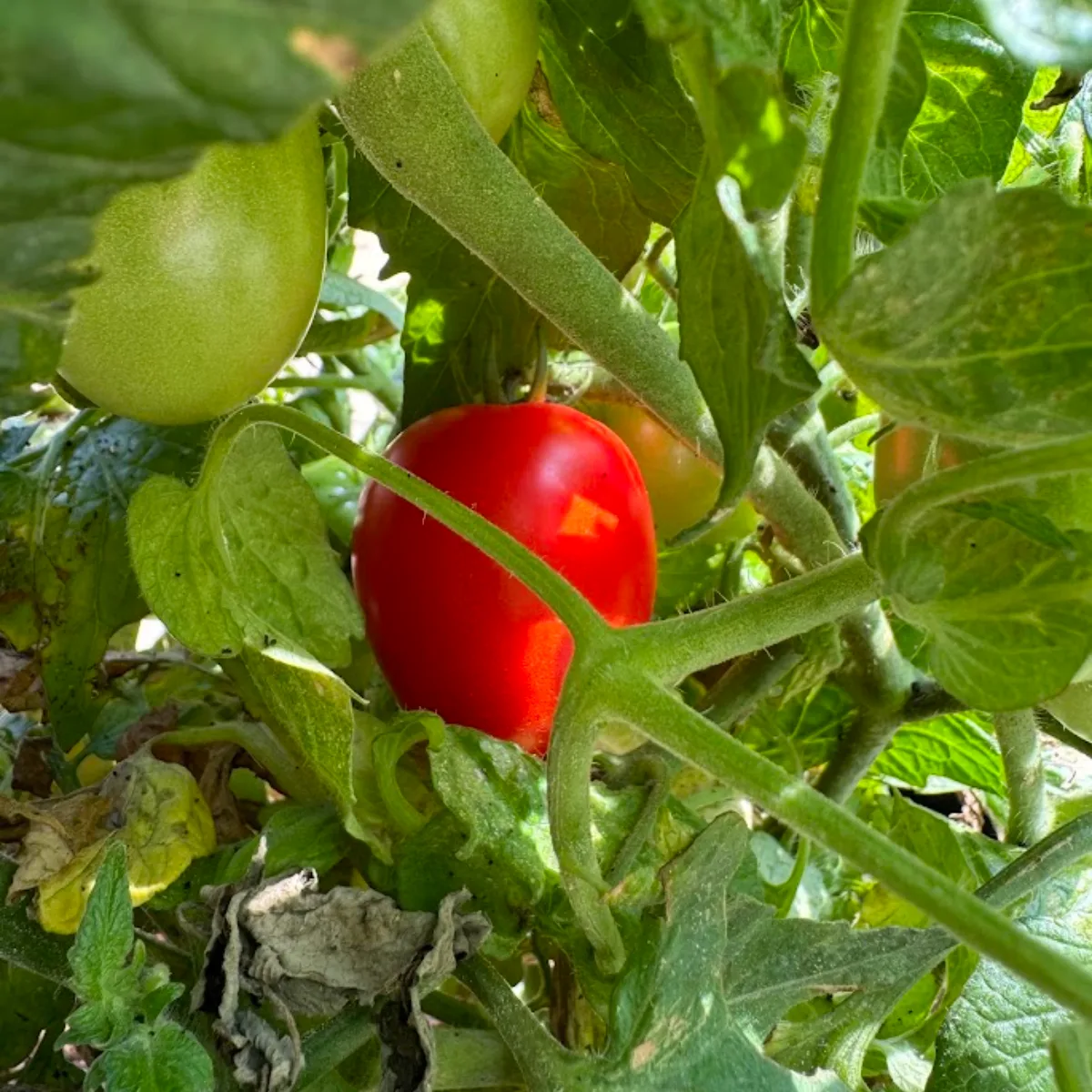
Quick Care Reference
| Care Aspect | Requirement | Frequency |
|---|---|---|
| Watering | 1-2 inches (2.5-5 cm) per week | Deep soak every 2-3 days; daily for containers in heat |
| Light | Full sun, 6-8 hours | Morning sun preferred; light afternoon shade above 95°F (35°C) |
| Spacing | 24-36 inches (60-90 cm) apart | Set at planting; crowding drives disease |
| Fertilizer | Low-nitrogen once fruiting | Every 2-3 weeks after first fruit set |
| Support | Stake, cage, or trellis | Install at planting, not later |
Watering
Tomatoes want deep, even moisture rather than frequent sips. Give roughly 1 to 2 inches (2.5 to 5 cm) of water a week, delivered in one or two long soakings so it reaches the deeper roots. In midsummer heat a plant in the ground often needs water every 2 to 3 days; one in a container can need it daily, sometimes twice. Water at the soil surface and keep the leaves dry, because wet foliage is how most tomato diseases start. Inconsistency is the real problem here: soil that swings from bone dry to saturated is what causes blossom end rot and split fruit, not a shortage of water overall. A 2 inch (5 cm) mulch layer does more to even that out than any change to your schedule.
Light Requirements
Full sun means 6 to 8 hours of direct light, and tomatoes genuinely use all of it. Less than 6 hours gives you a healthy-looking plant that flowers late and sets little fruit, which is the most common disappointment among first-time growers. Morning sun is worth more than afternoon sun because it dries dew off the leaves early and lowers disease pressure. In regions where summer afternoons run above 95°F (35°C), light afternoon shade actually helps, because pollen stops working in that kind of heat. See the temperature notes below for what that does to fruit set.
Humidity & Temperature
Outdoor ambient humidity is what you get, and tomatoes are not fussy about it. Temperature matters far more. Fruit sets best between 70 and 85°F (21 to 29°C). Above 90°F (32°C) by day, below 55°F (13°C) at night, or above 75°F (24°C) at night, flowers commonly drop without setting fruit. That is a pause rather than a problem, and it ends when the weather turns. Do not plant out until night temperatures hold above 50°F (10°C) and the soil has reached 60°F (16°C); cold soil stalls a transplant for weeks in a way it never fully recovers from. High humidity with crowded plants invites fungal disease, so spacing and airflow matter more in humid climates than in dry ones.
Fertilizing
Work a balanced fertilizer or compost into the bed before planting. Once the first fruit has set, switch to a feed with less nitrogen relative to phosphorus and potassium. That means less, not none: the plant still needs nitrogen to keep making leaves, and many growers side-dress at first fruit set. Feed every 2 to 3 weeks through the season. The classic mistake is staying on a high-nitrogen feed, which gives a tall, dark green, handsome plant carrying almost no fruit. Container plants need feeding more often than beds, because watering flushes nutrients out the bottom, and a potted plant going pale from the bottom up is usually short of nitrogen rather than diseased.
Propagation
Tomatoes are grown from seed each year, but they also root from cuttings more readily than almost any garden plant, which is useful for a late second crop.
From seed
- Sow indoors 6 to 8 weeks before your last frost date
- Keep soil at 70 to 80°F (21 to 27°C) until germination, usually 5 to 10 days
- Give strong light immediately or seedlings stretch and weaken
- Harden off over 7 to 10 days before planting out
Suckers as cuttings
- Snap off a sucker 4 to 6 inches (10 to 15 cm) long from a leaf axil
- Stand it in water or push it into moist soil
- Roots appear in 7 to 14 days in warm weather
- Plant it out; it will fruit several weeks behind the parent
Saving seed
- Use open-pollinated or heirloom fruit only, not hybrids
- Scoop seed and pulp into a jar of water and leave 2 to 4 days to ferment
- Rinse clean, dry fully on a plate, and store somewhere cool and dark
Popular Varieties
Determinate (bush)
Grows to a set size, ripens most of its crop in a short window, and needs little pruning. Best for containers, small spaces, and anyone canning a batch at once.
Indeterminate (vining)
Keeps growing and fruiting until frost. Needs tall support and regular sucker removal. This covers most heirlooms and most cherry types.
Cherry and grape types
The most forgiving for a first year: fast to ripen and heavy cropping, and far less prone to blossom end rot than large slicing and paste varieties. Splitting is a different matter and depends on the variety rather than the size, so check for ones sold as crack-resistant.
Seasonal Care Calendar
Spring
Mar – May
- Sow seed indoors 6 to 8 weeks before the last frost. Give strong light from day one.
- Harden seedlings off gradually. Prepare the bed with compost.
- Plant out once nights hold above 50°F (10°C). Bury two thirds of the stem and add support immediately.
Summer
Jun – Aug
- Mulch and begin deep, regular watering. Tie in new growth weekly.
- Switch to low-nitrogen feed once the first fruit sets. Remove suckers on indeterminate types.
- Harvest regularly; picking keeps the plant producing. Expect a pause in flower set during extreme heat.
Fall
Sep – Nov
- Stop feeding. Pinch out the growing tips so the plant ripens what it already carries.
- Harvest before the first frost. Green fruit ripens indoors at room temperature.
- Pull spent plants and clear debris; do not compost diseased material.
Winter
Dec – Feb
- Nothing is growing outdoors in most of the country. Plan varieties and order seed.
- Rotate next season's bed if you can; tomatoes in the same soil year after year build up disease.
- Start seed indoors toward the end of this window in warmer zones.
Troubleshooting
Dark sunken patch on the blossom end of the fruit
Why it happens: Blossom end rot, caused by uneven watering disrupting calcium uptake rather than by a shortage of calcium in the soil
What to do: Water deeply and consistently, and mulch to hold moisture steady. Adding calcium rarely helps if the soil already has it. Affected fruit will not recover, but later fruit will be fine.
Ask the AI about this →Lower leaves yellowing and spotting, working upward
Why it happens: Early blight or septoria leaf spot, usually spread by soil splashing onto foliage. In containers, a plain shortage of nitrogen looks similar
What to do: Spotting with the yellowing means disease: remove affected leaves and bin them, mulch to stop splash, water at soil level, and improve airflow through spacing and pruning. Rotate the bed next season. Even yellowing with no spots, especially in a container, is usually hunger rather than blight, and a balanced feed fixes it.
Learn more: Why Are My Plant Leaves Turning Yellow → Ask the AI about this →Large greasy dark patches spreading fast on leaves and stems
Why it happens: Late blight, the disease behind the Irish potato famine, which arrives in cool wet weather and can kill a whole planting within days
What to do: This is the one tomato problem that is an emergency rather than a chore. Look for white fuzz on the underside of the patches in humid weather. Pull affected plants immediately, bag them and bin them; do not compost them. It spreads on the wind to potatoes as well, so tell anyone growing either nearby.
Ask the AI about this →Flowers appear, then drop without setting fruit
Why it happens: Temperatures outside the pollination range, or very high nitrogen
What to do: Above 90°F (32°C), or below 55°F (13°C) at night, pollen fails and the plant pauses. Wait it out. If the plant is lush and dark green with few flowers, cut back the nitrogen.
Ask the AI about this →Fruit splitting as it ripens
Why it happens: A heavy watering or rainfall after a dry spell, swelling the fruit faster than the skin can grow
What to do: Keep soil moisture even with mulch and regular deep watering. Pick ripening fruit ahead of forecast heavy rain. Split fruit is still fine to eat straight away.
Learn more: How Often Should I Water My Plant → Ask the AI about this →Plant wilts in the afternoon but recovers overnight
Why it happens: Normal heat stress if the soil is moist and the plant recovers overnight; root trouble or a soilborne wilt disease if it does not
What to do: Check the soil 2 inches (5 cm) down before acting. Moist soil with afternoon wilt that lifts overnight is the plant protecting itself and needs nothing. If the wilt is still there the next morning, cut through the lower stem and look for brown streaking inside: that points at fusarium or verticillium wilt and the plant will not recover. Wet, saturated soil instead points at root rot or poor drainage.
Learn more: Why Are My Plant Leaves Drooping → Ask the AI about this →Not sure what's wrong?
Premium includes AI photo diagnosis, then walks you through the fix and checks back in until it's better.
See Premium →Track your Tomato with PlantCareAI
Add your Tomato and get a watering schedule tuned to this week's weather. Free for up to 3 plants.
Add your Tomato