
African Violet Care Guide
Saintpaulia
Also known as Saintpaulia
By Ellen Hermance · PlantCareAI Editorial
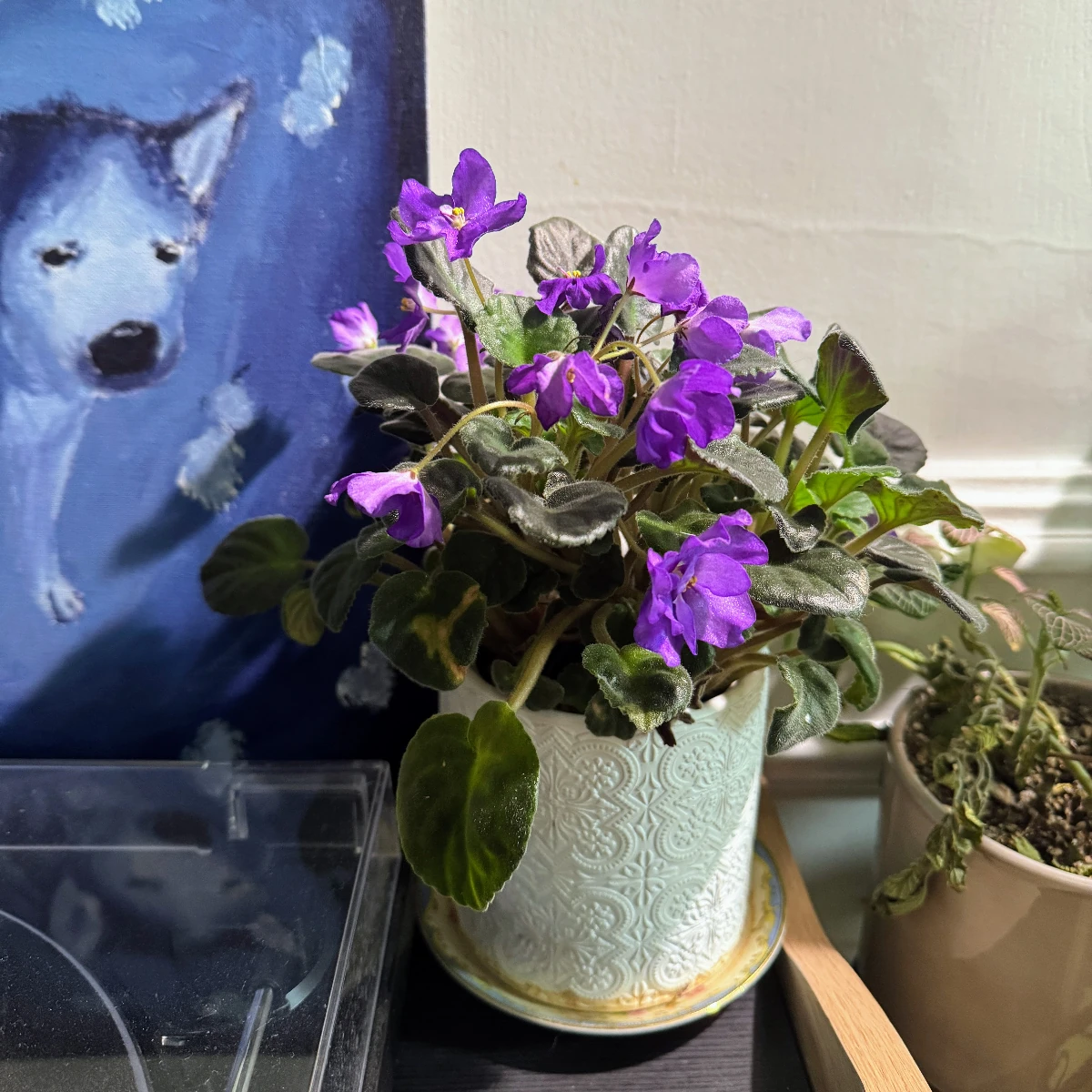
African Violets are compact flowering houseplants that bloom almost continuously when given the right conditions: bright indirect light, consistent warmth, and careful watering that keeps water off the leaves. Their fuzzy, rounded leaves and clusters of purple, pink, or white flowers make them one of the most popular flowering houseplants in the world. They are small enough for windowsills and shelves, and a well-cared-for plant will bloom year-round for many years.
Quick Care Reference
| Care Aspect | Requirement | Frequency |
|---|---|---|
| Watering | Top inch dry; bottom water | Every 7-14 days |
| Light | Bright indirect, 10-14 hrs/day | Grow light or east/north window |
| Humidity | 40-60% | No misting; avoid vents |
| Fertilizer | African Violet fertilizer | Every 2-4 weeks year-round |
| Repotting | African Violet mix | Every 1-2 years; same-size or smaller pot |
Watering
Water carefully from the bottom: set the pot in a shallow saucer of room-temperature water for 20 to 30 minutes, then drain. Alternatively, water slowly around the base of the plant, avoiding the leaves. Never use cold water; it causes white spots on the fuzzy leaves that are permanent. Water when the top inch of soil is dry, roughly every 7 to 14 days. African Violet-specific potting mix retains moisture without becoming waterlogged and is worth using.
Light Requirements
African Violets need bright indirect light for reliable blooming. A north- or east-facing window provides the gentlest light; west-facing windows can work with a sheer curtain. They should receive 10 to 14 hours of light per day. Grow lights are an excellent option and produce vigorous, year-round blooming: position a full-spectrum LED 6 to 12 inches above the plant for 12 to 14 hours. Direct sun bleaches leaves and prevents flowering.
Humidity & Temperature
African Violets prefer moderate humidity between 40 and 60%. Average home humidity is usually sufficient. Avoid placing them near heating or air conditioning vents, which dry the air quickly. Keep temperatures consistently between 65 and 75°F (18 to 24°C). Cold temperatures below 60°F (16°C) and hot conditions above 80°F (27°C) both suppress blooming. Do not mist the leaves.
Fertilizing
Feed every 2 to 4 weeks year-round with an African Violet fertilizer formulated for flowering plants (look for a higher phosphorus ratio, such as 7-9-5). A flowering-specific fertilizer encourages continuous bloom production. Dilute to half the recommended strength and water from the bottom after fertilizing to prevent salt buildup in the soil.
Propagation
African Violets propagate readily from single leaf cuttings. A single leaf placed in water or moist potting mix will produce new plantlets at its base.
Leaf cuttings in water
- Select a healthy, mature leaf from the middle of the plant
- Cut the petiole (leaf stem) to about 1 to 1.5 inches long at a 45-degree angle
- Place the petiole in a small glass of room-temperature water
- Keep in bright indirect light; change water every few days
- Plantlets appear at the base of the petiole in 4 to 8 weeks; pot when they have 2 to 3 leaves
Leaf cuttings in soil
- Cut a healthy leaf with 1 to 1.5 inches of petiole
- Insert at a 45-degree angle into moist African Violet mix
- Cover loosely with a clear plastic bag to retain humidity
- Plantlets emerge at soil level in 6 to 10 weeks
- Separate and pot individual plantlets once they have their own leaves
Popular Varieties
Saintpaulia 'Optimara' series
Widely available commercial varieties with reliable year-round blooming in purple, pink, and white.
Saintpaulia 'Rob's Combustion'
Ruffled red and white bicolor flowers; a popular collector variety.
Saintpaulia 'Buckeye Priceless Pink'
Compact miniature form with bright pink double flowers.
Saintpaulia 'Blue Boy'
One of the original cultivars; classic deep purple-blue single flowers.
Seasonal Care Calendar
Spring
Mar – May
- Increase light as days lengthen. Feed every 2 weeks. Remove spent blooms.
- Peak blooming period for many varieties. Continue regular fertilizing.
- Propagate from leaf cuttings if desired. Remove all dead flowers and leaves.
Summer
Jun – Aug
- Move away from intense direct sun. Keep temperatures below 80°F (27°C).
- Continue bi-weekly or monthly fertilizing. Water carefully; heat dries soil faster.
- Remove spent blooms to encourage new flower buds to set.
Fall
Sep – Nov
- Move back to a bright window as outdoor light fades. Continue fertilizing.
- Add a grow light if needed to maintain 12 to 14 hours of light per day.
- Continue regular care. Consistent conditions are key to year-round blooming.
Winter
Dec – Feb
- Use a grow light if natural light is insufficient. Keep away from cold windows.
- Continue fertilizing every 2 to 4 weeks. Water carefully; avoid cold water.
- Maintain consistent temperature. African Violets can bloom through winter with good light.
Troubleshooting
White or yellow spots on leaves
Why it happens: Cold water contact on leaves
What to do: Spots are permanent. Water from the bottom only and use room-temperature water going forward.
Ask the AI about this →No flowers or stopped blooming
Why it happens: Insufficient light, wrong fertilizer, or temperature stress
What to do: Add a grow light for 12 to 14 hours daily, switch to African Violet fertilizer, and keep temperatures between 65 and 75°F (18 to 24°C).
Learn more: Best Grow Lights for Indoor Plants → Ask the AI about this →Yellow leaves
Why it happens: Overwatering, insufficient light, or nitrogen deficiency
What to do: Check soil moisture and reduce watering. Move to brighter indirect light. Resume regular fertilizing.
Learn more: Why Are My Plant Leaves Turning Yellow → Ask the AI about this →Powdery gray or white coating on leaves
Why it happens: Powdery mildew from poor air circulation
What to do: Improve air circulation, avoid overhead watering, and treat with a dilute baking soda or sulfur-based fungicide spray.
Learn more: Powdery Mildew on Houseplants → Ask the AI about this →Not sure what's wrong?
Premium includes AI photo diagnosis, then walks you through the fix and checks back in until it's better.
See Premium →Track your African Violet with PlantCareAI
Add your African Violet and get a watering schedule tuned to this week's weather. Free for up to 3 plants.
Add your African Violet