
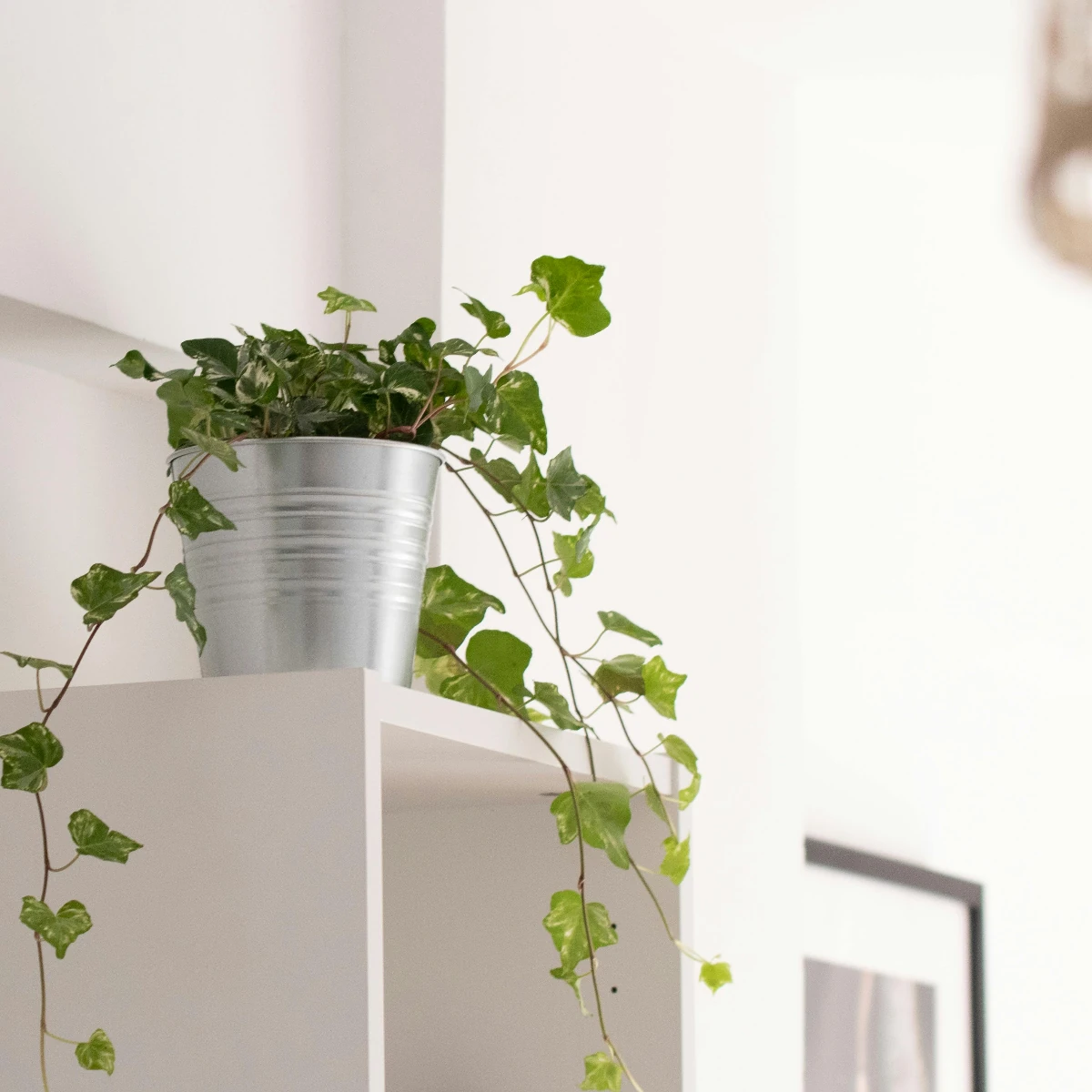
English Ivy is a classic trailing and climbing vine with distinctive lobed leaves that come in solid green, variegated, or miniature forms. Indoors it thrives in cool, bright conditions with consistent moisture and good humidity. Ivy is more demanding than many houseplants: it needs regular watering, dislikes dry air, and attracts spider mites when stressed. But in the right conditions it grows vigorously, trails beautifully from shelves, and is one of the most recognizable and elegant houseplants available.
Quick Care Reference
| Care Aspect | Requirement | Frequency |
|---|---|---|
| Watering | Top inch dry | Every 7-14 days |
| Light | Medium to bright indirect | Avoid intense afternoon direct sun |
| Humidity | 40-60% | Pebble tray or humidifier in dry climates |
| Fertilizer | Half-strength balanced | Every 2 weeks spring/summer |
| Repotting | Rich, well-draining mix | Every 1-2 years |
Watering
Keep the soil evenly moist but not soggy. Water when the top inch of soil feels dry, roughly every 7 to 14 days in spring and summer. Reduce to every 10 to 14 days in fall and winter. Ivy does not store water and wilts quickly when underwatered, but sitting in soggy soil causes root rot. Always use a pot with drainage holes and empty the saucer after 30 minutes. Cool, filtered, or rainwater is preferable; ivy is mildly sensitive to fluoride in tap water.
Light Requirements
English Ivy grows best in medium to bright indirect light. An east- or north-facing window is ideal for solid green varieties. Variegated forms need brighter light, such as a west-facing window, to maintain their cream or white markings. Ivy tolerates lower light than most bright-light plants but growth slows significantly and variegation fades. Avoid intense direct afternoon sun, which scorches leaves and dries soil too quickly.
Humidity & Temperature
English Ivy prefers higher humidity, ideally 40 to 60%. In dry indoor air, especially during winter heating, leaves may turn crispy at the tips and spider mite pressure increases. Increase humidity by placing the pot on a pebble tray with water, grouping with other plants, or running a small humidifier nearby. Temperatures between 50 and 75°F (10 to 24°C) are ideal; ivy performs better in cool rooms and struggles in temperatures above 80°F (27°C).
Fertilizing
Feed every 2 weeks in spring and summer with a balanced liquid fertilizer diluted to half strength. Ivy is a moderate feeder during its active growing season. Reduce to monthly in early fall and stop entirely in winter. Over-fertilizing causes excessive leggy growth and reduces leaf density.
Propagation
English Ivy propagates readily from stem cuttings placed in water or moist potting mix. Roots form within 3 to 4 weeks.
Stem cuttings in water
- Cut a 4 to 6 inch stem just below a leaf node
- Remove leaves from the bottom half of the cutting
- Place in a glass of water in bright indirect light
- Change water every 3 to 4 days to prevent bacteria
- Transfer to potting mix once roots reach 1 to 2 inches
Stem cuttings in soil
- Prepare a small pot with moist well-draining potting mix
- Dip the cut end in rooting hormone (optional)
- Insert into the soil so at least one node is buried
- Cover loosely with a plastic bag to retain humidity
- Remove the cover after roots establish in 3 to 4 weeks
Popular Varieties
Hedera helix 'Glacier'
Silver-gray and white variegated leaves with a compact trailing habit.
Hedera helix 'Goldchild'
Green leaves edged in golden yellow; needs bright light to maintain color.
Hedera helix 'Needlepoint'
Miniature star-shaped leaves on a delicate trailing vine; great for terrariums.
Hedera helix 'Shamrock'
Dense, compact growth with dark green deeply lobed leaves.
Seasonal Care Calendar
Spring
Mar – May
- Resume bi-weekly fertilizing. Increase watering as growth picks up.
- Active growth period. Water regularly and feed every 2 weeks.
- Check for spider mites as temperatures rise. Rinse leaves if detected.
Summer
Jun – Aug
- Move away from hot south or west windows. Increase humidity if air conditioning dries the room.
- Water every 7 to 10 days. Continue bi-weekly feeding. Inspect for spider mites.
- Trim long trailing stems to encourage density. Root cuttings in water.
Fall
Sep – Nov
- Reduce fertilizing to monthly. Water every 10 to 14 days.
- Stop fertilizing. Continue regular watering as growth slows.
- Monitor humidity as heating turns on. Use pebble tray if needed.
Winter
Dec – Feb
- Keep away from cold drafts and heating vents. Water every 10 to 14 days.
- No fertilizer. Monitor for spider mites; dry heated air increases risk.
- Continue cool, bright, moist conditions. Trim any dead or leggy growth.
Troubleshooting
Fine webbing on leaves
Why it happens: Spider mite infestation
What to do: Rinse the entire plant with a strong water spray, then treat with neem oil or insecticidal soap every 5 to 7 days for 3 weeks. Increase humidity.
Learn more: How to Treat Spider Mites → Ask the AI about this →Yellowing leaves
Why it happens: Overwatering, root rot, or natural aging of lower leaves
What to do: Check soil drainage and reduce watering. Remove yellowed leaves. Repot if roots are soggy.
Learn more: Why Are My Plant Leaves Turning Yellow → Ask the AI about this →Crispy brown leaf tips
Why it happens: Low humidity or underwatering
What to do: Increase watering frequency and add a pebble tray with water beneath the pot.
Learn more: Why Are My Plant Leaves Turning Brown → Ask the AI about this →Leggy stems with large gaps between leaves
Why it happens: Insufficient light
What to do: Move to a brighter location and trim leggy stems. Cuttings can be propagated.
Ask the AI about this →Not sure what's wrong?
Premium includes AI photo diagnosis, then walks you through the fix and checks back in until it's better.
See Premium →Track your English Ivy with PlantCareAI
Add your English Ivy and get a watering schedule tuned to this week's weather. Free for up to 3 plants.
Add your English Ivy