
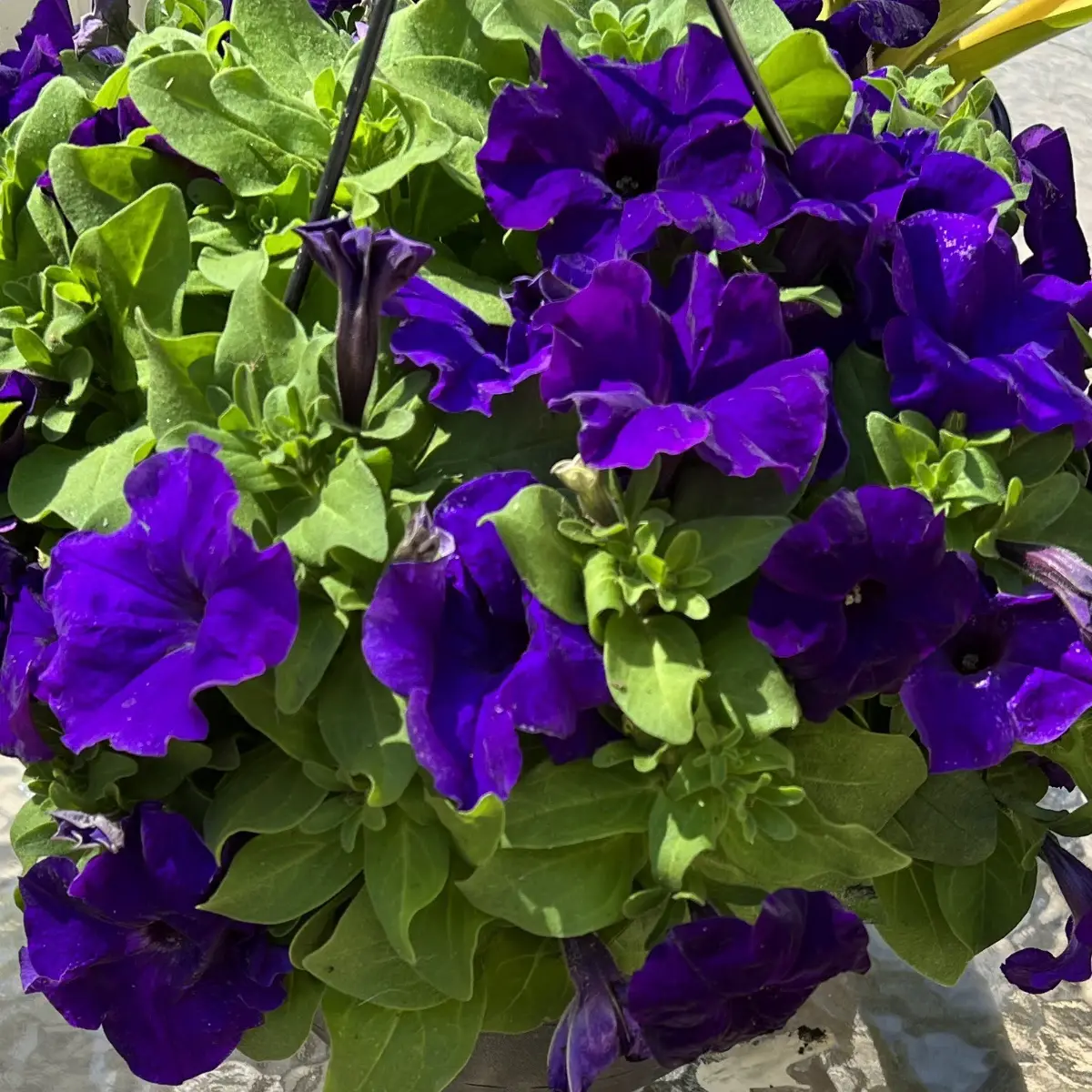
Petunias are the workhorse flower of hanging baskets and window boxes, blooming from late spring until frost if they get three things: full sun, steady water and regular food. Most petunia problems come from running short of one of them. They also get leggy by midsummer, and a hard cutback then is what keeps them full and flowering into fall. The slightly sticky feel of the leaves and stems is normal.
Quick Care Reference
| Care Aspect | Requirement | Frequency |
|---|---|---|
| Watering | Water when the surface is dry | Daily for baskets in summer; every 2-3 days in the ground |
| Light | Full sun, 6-8 hours | Fewer flowers in shade |
| Fertilizer | Balanced liquid feed | Every 1-2 weeks in containers |
| Cutting back | Trim by a third to a half | Once in midsummer |
| Deadheading | Remove spent flowers and seed pods | Weekly for older types |
Watering
How often depends almost entirely on where the petunia is growing. In the ground, water deeply when the top inch (2.5 cm) of soil is dry, often every 2 to 3 days in summer. Hanging baskets and small containers dry out fast and may need water every day, twice on the hottest days. Water until it runs from the drainage holes, and let the surface dry slightly before watering again, since soggy roots rot. Water at the soil rather than over the flowers.
Light Requirements
Petunias need full sun, 6 hours or more, to flower well. In part shade they grow long and sparse with few flowers. They do well in hot, sunny spots such as balconies and the south side of a house, as long as their water keeps up.
Humidity & Temperature
Petunias are grown as annuals across most of the US. Plant out after the last frost, once nights stay above about 50°F (10°C). They grow best between 60 and 85°F (16 to 29°C) and keep blooming through summer heat if well watered and fed. Light frost damages them and a hard frost kills them. Long rainy spells can batter older large-flowered types and leave them looking ragged.
Fertilizing
Petunias are heavy feeders, especially in containers where watering washes nutrients out. Mix a slow-release fertilizer into the potting mix at planting, then feed with a balanced liquid fertilizer every 1 to 2 weeks from midsummer on. Pale or yellowing new leaves in containers often mean the plant cannot take up iron; a fertilizer for acid-loving plants or one with added iron usually fixes it.
Propagation
Petunias can be grown from seed, but the seed is tiny and slow. Most gardeners buy transplants, and many popular spreading varieties are sold only as plants.
From seed indoors
- Sow 10 to 12 weeks before the last frost
- Press the dust-fine seed onto the surface without covering it; it needs light to germinate
- Keep at 70 to 75°F (21 to 24°C); seedlings appear in 1 to 2 weeks
- Keep seedlings under strong light and transplant after the last frost
Stem cuttings
- In late summer, cut 3 to 4 inch (8 to 10 cm) shoot tips without flowers
- Strip the lower leaves and insert in moist potting mix
- Keep in bright, indirect light; roots form in 2 to 3 weeks
- Keep growing it in a sunny window to overwinter a favorite plant
Popular Varieties
Grandiflora petunias
Large flowers up to 4 inches (10 cm) across. The showiest, but the most easily battered by rain.
Multiflora petunias
Smaller flowers in greater numbers on compact plants. Recover from rain faster and suit beds and borders.
Spreading petunias
Low, trailing plants that cover 2 to 4 feet (60 to 120 cm) and spill from baskets. Most need little deadheading.
Seasonal Care Calendar
Spring
Mar – May
- Start seed indoors 10 to 12 weeks before the last frost, or buy transplants.
- Plant out after the last frost with slow-release fertilizer in the mix.
- Pinch young plants once to encourage branching.
Summer
Jun – Aug
- Water containers daily. Feed every 1 to 2 weeks.
- Cut back leggy plants by a third to a half in midsummer.
- Check flower buds for budworm damage.
Fall
Sep – Nov
- Plants often bloom well into fall with regular feeding.
- Take cuttings of favorites to overwinter indoors.
- Pull plants after frost.
Winter
Dec – Feb
- Keep overwintering cuttings in a bright, cool window.
- Start seed indoors toward the end of this window.
- Plan containers and baskets for spring.
Troubleshooting
Long, bare stems with flowers only at the tips
Why it happens: Normal midsummer legginess, made worse by too little sun or food
What to do: Cut every stem back by a third to a half and feed. Plants regrow full and flower again within a couple of weeks.
Learn more: Why Is My Plant Not Growing? → Ask the AI about this →Pale or yellow new leaves with green veins
Why it happens: Iron chlorosis: the plant cannot take up iron, usually because the potting mix pH has drifted high
What to do: Feed with a fertilizer for acid-loving plants or one with chelated iron. Repotting in fresh mix also helps.
Learn more: Why Are My Plant Leaves Turning Yellow? → Ask the AI about this →Holes in flower buds and flowers missing
Why it happens: Budworm caterpillars eating the buds; tiny black droppings are the giveaway
What to do: Hand-pick caterpillars and remove damaged buds. Bt, a bacterial spray that only affects caterpillars, controls them if applied while they are small.
Learn more: Plant Pest Identification Guide → Ask the AI about this →Whole plant wilts in moist soil and does not recover
Why it happens: Root rot from waterlogged soil or a container without drainage
What to do: Let the soil dry and make sure the container drains. Plants with brown, mushy roots rarely recover; replace them in fresh mix.
Learn more: How to Treat Root Rot → Ask the AI about this →Wilting every afternoon in a hanging basket
Why it happens: Not enough water for a small pot in sun and wind
What to do: Water more often, move to a larger basket, or add a water-holding liner. Plants that recover when watered are fine.
Learn more: Why Are My Plant Leaves Drooping? → Ask the AI about this →Not sure what's wrong?
Premium includes AI photo diagnosis, then walks you through the fix and checks back in until it's better.
See Premium →Track your Petunia with PlantCareAI
Add your Petunia and get a watering schedule tuned to this week's weather. Free for up to 3 plants.
Add your Petunia