
Best Air-Purifying Plants: 13 NASA-Backed Picks (2026)
By Ellen Hermance · PlantCareAI Editorial
The air inside your home is 2–5 times more polluted than outdoor air, according to the EPA. Furniture off-gasses formaldehyde, cleaning products release volatile organic compounds (VOCs), and carpets trap benzene and trichloroethylene. In 1989, NASA's Clean Air Study identified specific houseplants that actively remove these pollutants from indoor air through their leaves, roots, and associated soil microorganisms. While a few plants won't replace a HEPA filter, the science is clear: certain houseplants measurably reduce concentrations of common indoor toxins. This guide covers the 9 most effective air-purifying houseplants based on NASA's research and subsequent studies, with honest assessments of how much purification you can realistically expect, care requirements for each plant, and which ones are safe for homes with pets or children.
Quick Answer: The best air-purifying houseplants backed by NASA research are peace lily (removes all 5 tested toxins), snake plant (filters air day and night), spider plant (95% formaldehyde removal, pet-safe), Boston fern (top formaldehyde remover, pet-safe), and pothos (removes formaldehyde and benzene). For pet-safe homes, choose spider plants, Boston ferns, bamboo palms, and gerbera daisies. Aim for 1 plant per 100 sq ft for meaningful air quality improvement.
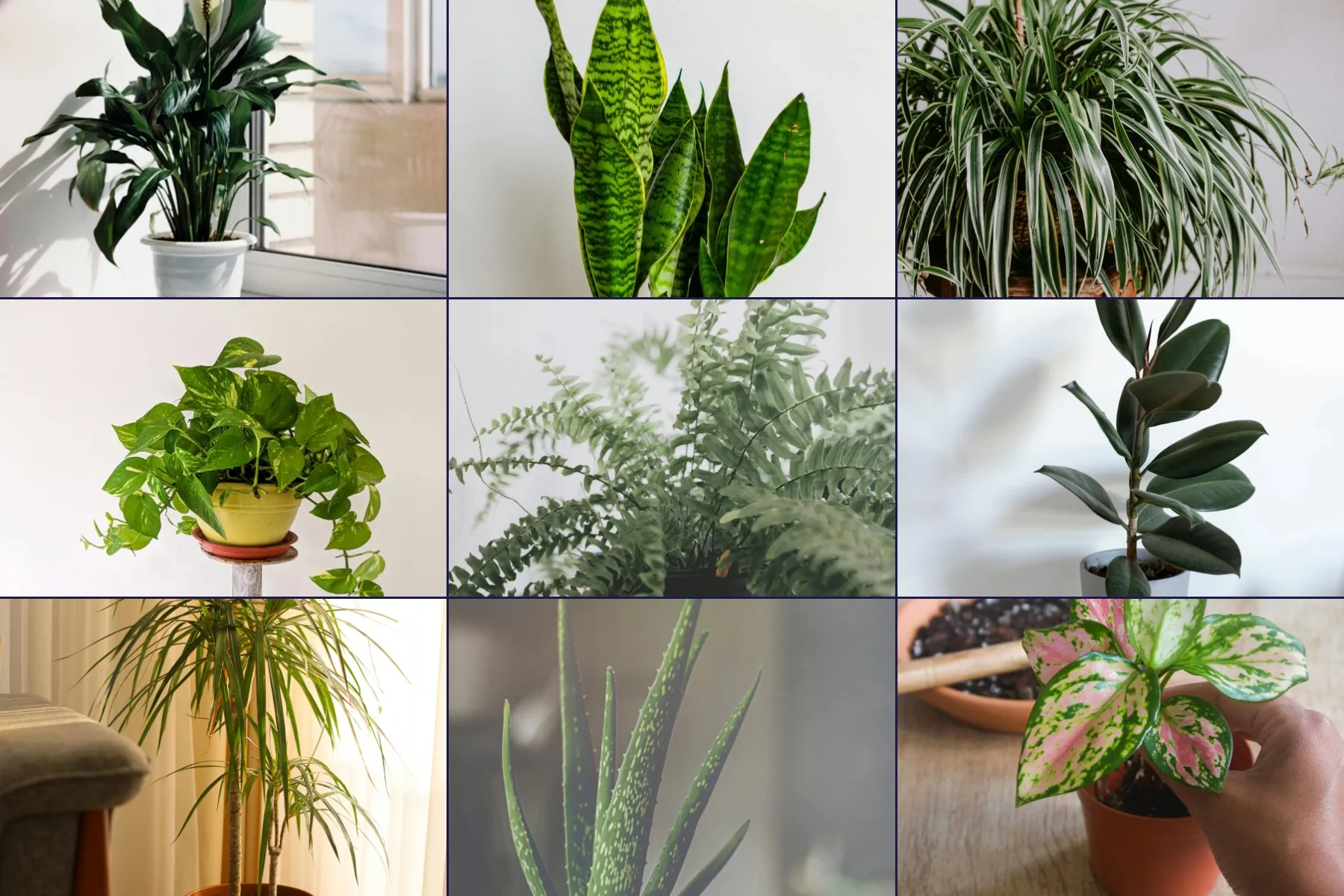
Top Air-Purifying Houseplants Ranked by Effectiveness
-
Peace Lily (Spathiphyllum wallisii)
The peace lily topped NASA's clean air study by removing all five tested pollutants: formaldehyde, benzene, trichloroethylene, xylene, and ammonia; the only plant to score across all categories. Its broad, dark green leaves and elegant white spathes make it one of the most attractive air purifiers available. Peace lilies thrive in low to medium light, making them effective in offices and rooms without direct sunlight. They're also "communicators"; the leaves droop dramatically when thirsty, then perk back up within hours of watering, making them nearly impossible to accidentally kill from underwatering. One peace lily per 100 square feet provides meaningful air purification based on NASA's chamber studies.
How to fix it: Place in low to medium indirect light, water when leaves begin to droop slightly, and wipe leaves monthly to keep stomata clear for maximum air filtration. Note: mildly toxic to cats and dogs; place out of pet reach or choose a pet-safe alternative like a Boston fern.
-
Snake Plant (Sansevieria trifasciata / Dracaena trifasciata)
The snake plant is unique among air purifiers because it performs CAM (crassulacean acid metabolism) photosynthesis; meaning it absorbs CO₂ and releases oxygen at night, unlike most plants that only do this during the day. This makes it ideal for bedrooms. NASA's study found it effectively removes formaldehyde, benzene, trichloroethylene, and xylene. Snake plants are nearly indestructible: they tolerate low light, infrequent watering, temperature fluctuations, and even extended neglect. Their upright, architectural growth habit fits modern interior design, and they come in dozens of varieties from the classic Laurentii (yellow-edged) to the compact Hahnii (bird's nest).
How to fix it: Place anywhere from bright indirect to low light, water every 2–3 weeks (less in winter), and use a well-draining potting mix. Snake plants are mildly toxic to pets; place on elevated surfaces or choose the pet-safe spider plant as an alternative nighttime oxygen producer.
-
Spider Plant (Chlorophytum comosum)
NASA's study showed spider plants remove 95% of formaldehyde from a sealed chamber within 24 hours; one of the highest removal rates tested. They also effectively filter carbon monoxide and xylene. Spider plants are completely non-toxic to cats and dogs, making them the best air purifier for pet-owning households. They produce copious "babies" (plantlets), so one purchase quickly becomes a collection that can purify multiple rooms. Spider plants are forgiving of neglect, tolerate a wide range of conditions, and are recommended as ideal starter plants by virtually every plant care resource. Their cascading growth habit makes them perfect for hanging baskets near pollution sources like kitchen stoves.
How to fix it: Hang near windows in bright indirect light for maximum growth and purification. Water when top inch of soil is dry. Propagate the dangling plantlets to place air-purifying spider plants throughout your home; each baby can be rooted in water or directly in soil.
-
Pothos / Devil's Ivy (Epipremnum aureum)
Pothos earned its place on NASA's list by effectively removing formaldehyde, benzene, and carbon monoxide from indoor air. It's one of the easiest houseplants to grow; pothos thrives in everything from bright indirect light to dim office fluorescents, handles irregular watering without complaint, and grows rapidly, producing long trailing vines that can be trained up moss poles or draped from shelves. A single pothos vine can grow several feet per year, maximizing the leaf surface area available for air filtration. The golden, marble queen, and neon varieties are most common, but all pothos varieties share the same air-purifying capabilities.
How to fix it: Place in any light condition, water when soil is dry, and trim vines to encourage bushier growth. Train up a moss pole for more leaf surface area (and more air purification). Note: toxic to cats and dogs; keep vines trimmed and out of pet reach.
-
Boston Fern (Nephrolepis exaltata)
Boston ferns were the top formaldehyde remover in NASA's study and also showed effectiveness against xylene and toluene. Their dense, feathery fronds provide enormous leaf surface area relative to their pot size, maximizing air filtration capacity. Boston ferns are completely pet-safe, making them an excellent choice for homes with cats and dogs. They act as natural humidifiers, releasing moisture through their fronds, which helps combat dry indoor air during heating season. This dual function; air purification plus humidity; makes them particularly valuable in winter when homes are sealed tight and air quality is at its worst.
How to fix it: Keep soil consistently moist (not soggy), provide bright indirect light, and maintain humidity above 50%. Hang near formaldehyde sources like new furniture, carpeting, or pressed-wood cabinets. Mist daily in dry environments or use a pebble tray.
-
Rubber Plant (Ficus elastica)
Rubber plants are formaldehyde-removing powerhouses. Their large, thick, glossy leaves provide substantial surface area for absorbing airborne toxins, and they're more tolerant of low light and inconsistent care than most ficus species. Rubber plants can grow into impressive indoor trees (6–10 feet tall), creating a dramatic statement while quietly cleaning your air. The burgundy variety (with deep reddish-purple leaves) and the variegated Tineke (with cream and pink edges) are popular for their decorative appeal. Unlike their fussy cousin the fiddle leaf fig, rubber plants tolerate imperfect conditions and recover quickly from stress.
How to fix it: Place in bright indirect light (tolerates medium), water when top 2 inches of soil are dry, and wipe leaves monthly with a damp cloth to keep stomata clear. Rotate quarterly for even growth. The sap is mildly irritating; wear gloves when pruning.
-
English Ivy (Hedera helix)
English ivy was the top benzene remover in NASA's study, reducing concentrations by 89.8% in 24 hours. It also removes formaldehyde, trichloroethylene, and xylene. Research from the American College of Allergy, Asthma & Immunology found that English ivy reduced airborne mold by 78% in 12 hours, making it valuable for people with mold allergies. Its vigorous trailing growth provides maximum leaf coverage, and it thrives in cool temperatures (50–70°F) that would stress tropical houseplants. English ivy is excellent for unheated rooms, basements, and garages where air quality tends to be poorest.
How to fix it: Provide bright indirect light and cool temperatures. Keep soil evenly moist and mist frequently; ivy is prone to spider mites in dry air. Note: toxic to pets and can cause skin irritation in humans. Best for pet-free households or rooms pets cannot access.
-
Not sure which air-purifying plants suit your home's light conditions, pets, and layout?
Get a personalized recommendation → -
Bamboo Palm (Chamaedorea seifrizii)
The bamboo palm is a top-rated air purifier that is also completely non-toxic to pets, making it one of the best choices for households with animals. NASA found it effective against formaldehyde, benzene, and trichloroethylene. Bamboo palms can grow 4–12 feet tall indoors, providing substantial air-filtering leaf surface area while creating a tropical ambiance. They also act as natural humidifiers, transpiring up to a liter of water per day, which improves air moisture levels in dry indoor environments. Their multi-stemmed, clumping growth habit means each plant has more filtering capacity than single-trunk palms.
How to fix it: Place in bright indirect light, water when top inch of soil is dry, and ensure the pot has excellent drainage. Feed monthly during the growing season. Watch for spider mites in dry conditions; regular misting helps prevent infestations.
-
Dracaena (Dracaena spp.)
The dracaena genus includes several NASA-tested air purifiers: Dracaena marginata (dragon tree), Dracaena deremensis (Janet Craig and Warneckei), and Dracaena fragrans (corn plant). Collectively, they remove formaldehyde, benzene, trichloroethylene, and xylene. Dracaenas are architecturally striking, with varieties ranging from the spiky dragon tree to the broad-leafed corn plant. They're slow-growing, long-lived, and tolerant of low light; some specimens thrive for decades indoors. Their height (up to 6 feet) and density of foliage make them effective large-scale air purifiers for living rooms and offices.
How to fix it: Place in low to bright indirect light, water when top half of soil is dry (they're drought-tolerant), and avoid fluoridated water, which causes leaf tip browning. Trim brown tips with sharp scissors. Mildly toxic to pets; place in pet-restricted areas.
-
Aloe Vera (Aloe barbadensis miller)
Aloe vera earned its place in NASA's study by removing formaldehyde and benzene; pollutants released by paint, varnishes, and cleaning products. Like snake plants, aloe performs CAM (crassulacean acid metabolism) photosynthesis, absorbing CO₂ and releasing oxygen at night, making it doubly effective in bedrooms. Beyond air purification, aloe's gel provides immediate relief for minor burns and skin irritation; making it the most multi-functional plant on this list. Aloe is nearly indestructible: it stores water in its thick leaves and can go weeks without watering. The main failure mode is overwatering, which causes root rot. It thrives in bright light and requires almost no maintenance beyond monthly watering.
How to fix it: Place in the brightest spot in your home; a south or west-facing windowsill is ideal. Water deeply, then allow soil to dry out completely before watering again (every 3–4 weeks in summer, every 6–8 weeks in winter). Use a cactus or succulent mix for excellent drainage. Note: toxic to cats and dogs; keep out of pet reach despite its medicinal uses.
-
Chinese Evergreen (Aglaonema spp.)
Chinese evergreens were among NASA's top plants for removing benzene and formaldehyde from indoor air. What makes them especially valuable is their extraordinary adaptability; they're one of the few NASA-tested air purifiers that genuinely tolerate deep shade, making them effective in interior offices, dim hallways, and rooms without direct light. Aglaonemas come in a range of foliage: classic dark green (most shade-tolerant), silver-streaked varieties, and bold red and pink cultivars that need brighter conditions. Their lush, tropical appearance belies how easy they are; Chinese evergreens are slow-growers that rarely need repotting and tolerate missed waterings without complaint.
How to fix it: Match variety to light: dark-leafed varieties for low light, brightly colored varieties for medium light. Water when the top half of soil is dry and never let roots sit in standing water. Feed with a balanced fertilizer quarterly in the growing season. Note: mildly toxic to pets and can cause oral irritation in cats, dogs, and small children.
-
Heart-Leaf Philodendron (Philodendron hederaceum)
Heart-leaf philodendrons are one of NASA's most-studied air purifiers and among the most effective at removing formaldehyde. Their rapid growth rate; producing new leaves weekly during the growing season; creates high leaf surface area quickly, which is directly correlated with air filtration capacity. A single philodendron trained up a moss pole can produce dozens of leaves within a year, filtering a significantly larger air volume than the same plant trailing from a shelf. Philodendrons tolerate low light, irregular watering, and low humidity; conditions that would stress more demanding plants; making them among the easiest air purifiers to maintain long-term.
How to fix it: Provide bright to medium indirect light for fastest growth (more leaves = more filtration). Water when the top inch of soil is dry and pinch growing tips to encourage branching and denser foliage. Train up a moss pole for vertical growth and maximum leaf coverage. Note: toxic to pets and humans; the sap contains calcium oxalate crystals that cause oral irritation. Wash hands after handling.
-
Gerbera Daisy (Gerbera jamesonii)
Gerbera daisies are NASA's highest-rated plants for removing benzene and trichloroethylene; the solvent used in dry cleaning that commonly enters homes via freshly dry-cleaned clothing and fabrics. Like snake plants and aloe, gerberas release oxygen at night, making them beneficial in bedrooms. They're the only flowering plant in NASA's top list, adding color (red, orange, yellow, pink) alongside their air-filtering function; ideal for laundry rooms and closets near dry-cleaned garments, where trichloroethylene concentrations are highest. Gerberas require more care than most plants on this list: they need abundant bright light and regular deadheading, but they're completely non-toxic to pets.
How to fix it: Place in a south-facing window for at least 6 hours of bright light daily. Water at the base (avoid wetting leaves or the crown, which promotes rot). Deadhead spent blooms to extend flowering. Non-toxic to cats and dogs; one of the few blooming, pet-safe air purifiers on NASA's list. Ideal for laundry rooms and spaces with dry-cleaning exposure.
Watch: What Your Houseplants Are Doing to Your Brain
The 1989 NASA study behind this list is only part of the picture. This Elloquist video covers what else the research says houseplants do for the people living with them.
By Elloquist · Watch on YouTube
What this video covers
- Mycobacterium vaccae, a bacterium found in ordinary soil, activates the same serotonin pathway that antidepressants target (Lowry et al., Neuroscience, 2007).
- Roger Ulrich's 1984 study in Science found surgical patients whose window looked onto trees recovered faster, and needed fewer strong painkillers, than patients facing a brick wall.
- Attention Restoration Theory (Kaplan and Kaplan, 1989) explains why looking at plants replenishes depleted focus in a way that screen breaks do not.
- The 1989 NASA clean air study is the origin of nearly every air-purifying plant claim online, and the video covers what it actually measured against what it gets used to say.
- E.O. Wilson's Biophilia (1984) argues the human pull toward living things is inherited rather than learned, which is why a plant on a desk changes how a room feels.
Chapters
- 0:00 The Soil Bacterium That Acts Like an Antidepressant
- 0:31 What We Lost When We Moved Indoors
- 1:06 The Soil Microbe: Mycobacterium vaccae and Serotonin
- 3:23 What the Research Does Not Show
- 4:34 The 1989 NASA Air Study
- 5:10 The Restorative Mind: Hospital Windows and Attention Restoration
- 6:47 Born for This: Biophilia, Why Green Signals Safety
- 9:40 What This Means for Your Windowsill
Read the full transcript
0:00 The Soil Bacterium That Acts Like an Antidepressant
Scientists discovered that a bacterium hiding in ordinary soil activates the same brain chemistry that antidepressants target. Not metaphorically. Biologically. Your relationship with plants isn't just a hobby.
It might be a prescription. And before you assume that's an exaggeration, let me show you the science. Because it goes much deeper than you think. It might explain why, since the pandemic, I've let dozens of plants quietly take over my home. Maybe I knew something my conscious mind didn't.
0:31 What We Lost When We Moved Indoors
We've lived alongside plants for our entire evolutionary history. For nearly all of that time, we were outside, hands in soil, surrounded by green, breathing air that had never seen a HEPA filter. Then, in the span of a few generations, we moved indoors. And something changed.
Today I want to show you what science is only now beginning to understand about what that shift cost us, and what your houseplants have been quietly doing for you all along.
1:06 The Soil Microbe: Mycobacterium vaccae and Serotonin
It started with a question nobody thought to ask. In 2007, a researcher named Christopher Lowry was working at the University of Bristol in the UK, studying a humble bacterium called Mycobacterium vaccae (my-koh-bak-TEER-ee-um VAK-eye), a microorganism that lives naturally in soil. Scientists had noticed something curious: cancer patients who were treated with it reported feeling unexpectedly better. Not physically.
Emotionally. Their quality of life improved in ways the treatment couldn't explain. Lowry wanted to know why. What he found was remarkable.
When he introduced a preparation of M. vaccae into mice, something lit up in their brains, a specific cluster of neurons that produce serotonin, the same chemical that antidepressants are designed to protect. The bacteria didn't just activate those neurons. It changed the animals' behavior. They became calmer, more resilient.
Less like mice under stress, and more like mice on Prozac. He published that finding in the journal Neuroscience. And then he kept going. After moving to the University of Colorado Boulder, Lowry built on that discovery across the following decade.
A 2016 study showed that injecting M. vaccae before a stressful event could prevent a PTSD-like syndrome in mice entirely, blocking the anxiety, blocking the stress-induced colitis, protecting the body as much as the mind. Then in 2019, his team identified the specific molecule responsible: a fatty acid hidden inside the bacterium that, when taken up by immune cells, shuts off the body's inflammatory cascade. That's the mechanism. That's the "special sauce," as Lowry called it, a single fat, evolved over millennia inside a microbe that lives in dirt, that tells your immune system to stand down.
He called what he was working toward a "stress vaccine." Not a metaphor. A literal immunization against the psychological damage of chronic stress. Pause on that for a moment. The soil beneath your feet contains organisms that co-evolved alongside us for hundreds of thousands of years, and they are still, quietly, trying to regulate our nervous systems. We just stopped listening.
3:23 What the Research Does Not Show
Now, before we go any further, I want to be straight with you about something. Because this is where the science gets genuinely interesting, and where the internet gets it wrong. The studies on M. vaccae were conducted on mice, using injections of heat-killed bacteria, not humans touching houseplant soil. Most commercial potting mix is steam-sterilized to kill pests and mold, which means it may contain very little of the bacteria that activated those serotonin neurons.
The trace amounts you encounter when you water your pothos are not, by themselves, a clinical substitute for antidepressant medication. What the research does show is something subtler, and in some ways, more interesting. The bacteria can become airborne when you water or disturb the soil. And researchers believe that even a trace of daily soil contact with these microbes, the kind of low-level exposure our ancestors had every day, may have meaningful cumulative effects on the immune system and stress response.
Dr. Lowry himself has described the goal as helping modern humans reconnect with "old friends", organisms we co-evolved with, and whose absence from our lives may be quietly costing us.
4:34 The 1989 NASA Air Study
There's a similar story with air quality. In 1989, NASA published a study showing that common houseplants could remove trace volatile organic compounds, or VOCs, from sealed laboratory chambers. The internet turned that into "plants clean your air." The honest version is more nuanced: in a real home with ventilation, open windows, and doors that open and close, plants work far too slowly to meaningfully change air quality. You'd need somewhere between 10 and 1,000 plants per square meter to match what a standard ventilation system does.
That's not a living room. That's a rainforest. But here's what's true. The benefits of houseplants on our minds and bodies are real, they just work through different pathways than the viral headlines suggest.
5:10 The Restorative Mind: Hospital Windows and Attention Restoration
Roger Ulrich demonstrated one of them in 1984, when he examined hospital records from a suburban Pennsylvania hospital. Surgical patients whose windows looked out on trees spent less time recovering than patients whose windows faced a brick wall, 7.96 days compared to 8.7. The difference wasn't aromatherapy or soil contact. It was simply the presence of something green and alive in their field of view.
And in the 1980s, environmental psychologists Rachel and Stephen Kaplan developed what they called Attention Restoration Theory to explain why. Their research, formally published in their 1989 book The Experience of Nature, proposed that nature replenishes a specific cognitive resource, the kind of focused, effortful attention we use for work, decisions, and screens. They called its depletion directed attention fatigue. And they found that natural environments, unlike cities or office environments, engage us in something different: soft fascination.
The effortless, involuntary attention you give to clouds moving, leaves shifting, water flowing. It doesn't demand anything from you. And that non-demand is exactly what allows the overworked parts of your brain to rest. A fern on your desk isn't filtering your air.
But it may be doing something quieter and stranger, answering a question your nervous system never stopped asking. It may be giving your mind permission to stop.
6:47 Born for This: Biophilia, Why Green Signals Safety
To understand why any of this works, you have to go back a very long way. In 1984, biologist E.O. Wilson published a book called Biophilia, a word first coined by psychologist Erich Fromm, meaning simply the love of life. Wilson's argument was this: we didn't just live in nature.
We became ourselves there. Our nervous systems were calibrated by it. Our threat-detection, our stress response, our sense of safety, all of it was shaped in our environments that were green, alive, and metabolically active. Which means that when we look at a healthy plant, something ancient in us pays attention.
Psychologists call part of this the Savanna Hypothesis. Humans across cultures show a consistent preference for landscapes that resemble the African savanna where our species first evolved, open spaces with scattered trees, access to water, long sightlines. We feel safest when we can see far and have somewhere to shelter. And we read green as a signal.
Lush vegetation means water. It means food. It means the environment can sustain life. Brown and barren means drought, scarcity, danger.
That signal still works. It runs beneath language, beneath conscious thought, through the oldest parts of the brain. When your amygdala registers a living, thriving plant, something ancient concludes: the environment is safe. Heart rate slows.
Cortisol drops. The parasympathetic nervous system, the rest-and-digest system, begins to take over from the fight-or-flight one. This is how patients in green hospital rooms redirect their body's energy toward healing rather than stress management. It's why workers with a plant in their sightline report higher concentration and lower anxiety.
It's why the fractal patterns of a fern, patterns that appear throughout nature, from coastlines to snowflakes, produce measurable relaxation responses in the brain. Wilson argued that our increasing separation from nature isn't just an aesthetic loss. He called the belief that we can flourish apart from the living world a delusion, one that had only arisen in the last moment of human history. In his view, what we experience as vague modern malaise, the background hum of depletion that no productivity hack can quite fix, is in part a biological consequence of living in environments our nervous systems were never built for.
Dr. Lowry's work adds one more layer. Those 'old friends' he's spent two decades studying, their presence near soil, near plants, may tell your immune system something ancient: you are where you belong. Stand down.
Your houseplants aren't a cure. But they may be a small, daily reminder to a very old part of you that the world is still alive.
9:40 What This Means for Your Windowsill
The next time you water your monstera or move your pothos a little closer to the window, you're doing something that goes deeper than decoration. You're tending something ancient in yourself, quietly, imperfectly, one plant at a time, for your own nervous system to rest. That's not small. In a world designed to keep you stimulated and on-task every waking hour, creating a small pocket of soft fascination in your own home might be one of the most genuinely radical things you can do.
And you probably already knew that. You just needed the science to confirm what your hands already understood. I've put together a list of the indoor plants researchers most consistently associate with soft fascination and stress recovery, it's linked in the description if you'd like a place to start. If this made you curious, there's more where this came from.
The world is more alive than we remember. I'm Elloquist, and I'll see you in the next one.
Air-Purifying Plant Comparison
All plants below are backed by NASA's 1989 Clean Air Study or subsequent research. Pet safety reflects ASPCA toxicity classifications.
| Plant | Removes | Pet Safe? | Light Needs | Research Highlight |
|---|---|---|---|---|
| Peace Lily | All 5 toxins | ❌ Mildly toxic | Low–medium | #1 Overall |
| Snake Plant | 4 toxins + night O₂ | ❌ Mildly toxic | Any light | #2 Versatility |
| Spider Plant | Formaldehyde, CO | ✅ Safe | Bright indirect | Top formaldehyde |
| Pothos | Formaldehyde, benzene | ❌ Toxic | Any light | Top 5 |
| Boston Fern | Formaldehyde, xylene | ✅ Safe | Bright indirect | #1 Overall (Wolverton) |
| Rubber Plant | Formaldehyde | ⚠️ Sap irritant | Bright indirect | Top 10 |
| English Ivy | Benzene, mold | ❌ Toxic | Bright indirect | #1 Benzene |
| Bamboo Palm | 3 toxins + humidity | ✅ Safe | Bright indirect | Top 5 |
| Dracaena | 4 toxins | ❌ Mildly toxic | Low–bright | Top 5 |
| Aloe Vera | Formaldehyde, benzene + night O₂ | ❌ Toxic | Bright/full sun | CAM nighttime O₂ |
| Chinese Evergreen | Benzene, formaldehyde | ❌ Mildly toxic | Low–medium | Best low-light pick |
| Heart-Leaf Philodendron | Formaldehyde | ❌ Toxic | Medium indirect | Fastest-growing |
| Gerbera Daisy | Benzene, trichloroethylene + night O₂ | ✅ Safe | Bright direct | Top benzene + pet-safe bloomer |
Frequently Asked Questions
- How many plants do you need to purify a room?
- NASA's original recommendation was 1 plant per 100 square feet of living space for meaningful air quality improvement. For a typical 1,800-square-foot home, that's 15–18 medium-sized plants. However, a 2019 study in the Journal of Exposure Science & Environmental Epidemiology suggested you'd need far more plants in real-world conditions (with natural air exchange) to match the sealed-chamber NASA results; potentially 10+ plants per room. The practical takeaway: houseplants contribute to air quality improvement but shouldn't replace proper ventilation, air purifiers, or removing pollution sources.
- Which houseplant removes the most toxins?
- The peace lily (Spathiphyllum) removed all five pollutants tested in NASA's study: formaldehyde, benzene, trichloroethylene, xylene, and ammonia. For specific toxins: English ivy was the top benzene remover (89.8% in 24 hours), Boston fern was the top formaldehyde remover, and spider plants removed 95% of formaldehyde in sealed tests. For pet-safe homes, spider plants and Boston ferns are the most effective options.
- Do air-purifying plants work at night?
- Most plants only photosynthesize during daylight hours, absorbing CO₂ and releasing O₂. At night, they respire like animals, taking in small amounts of O₂ and releasing CO₂. The exceptions are CAM plants; snake plants, aloe vera, and orchids; which absorb CO₂ at night and release oxygen, making them ideal bedroom plants. Air purification (removing VOCs and toxins) happens through passive absorption by leaves and soil microorganisms, which continues 24/7 regardless of light.
- Are air-purifying plants safe for babies and toddlers?
- Not all of them. Safe options for homes with small children include spider plants, Boston ferns, parlor palms, peperomias, and African violets. Avoid peace lilies, pothos, English ivy, philodendrons, and dieffenbachia; these contain calcium oxalate crystals or other compounds that cause mouth pain, swelling, and GI upset if chewed. Place any houseplant (even non-toxic ones) out of reach of children under 3, as soil and fertilizer can also pose choking or ingestion risks.
- Do bigger plants purify more air?
- Yes; air purification correlates with total leaf surface area, not pot size or plant count. A single large rubber plant or dracaena with dozens of large leaves will filter more air than several small succulents. Plants with broad, smooth leaves (rubber plant, peace lily) are generally more effective than those with small, narrow leaves. For maximum purification per plant, choose large-leafed species and keep leaves clean; dust buildup blocks the stomata (leaf pores) that absorb airborne pollutants.
- Which air-purifying plant is best for each room?
- Bedroom: snake plant or aloe vera; both produce oxygen at night and require minimal maintenance. Bathroom: Boston fern or peace lily; they thrive in humidity and filter airborne mold. Kitchen: spider plant or pothos; both absorb carbon monoxide from gas stoves and are easy to hang near the ventilation zone. Living room: rubber plant, bamboo palm, or dracaena; their size provides the leaf surface area needed for the largest room in your home. Home office: Chinese evergreen or dracaena; both tolerate low light and remove benzene, which is off-gassed by electronics and printer toner. Laundry room: gerbera daisy or English ivy; top performers against trichloroethylene from dry-cleaning solvents.
- How do houseplants actually remove air pollutants?
- Plants remove airborne pollutants through three mechanisms: (1) Stomata absorption; microscopic pores on leaves absorb chemicals like formaldehyde and benzene during photosynthesis, converting some toxins into plant nutrients. (2) Soil microorganism metabolism; bacteria and fungi in potting soil break down pollutants that reach the root zone; many researchers consider this the more impactful mechanism. (3) Root zone uptake; pollutants transported from leaves to roots are broken down by soil microorganisms. This is why healthy soil and healthy roots matter: an overwatered plant with root rot loses most of its air-purifying capacity. Repotting every 2–3 years refreshes the microbial community in the soil.
- What pollutants do air-purifying plants target?
- NASA's study tested for five main indoor pollutants: (1) Formaldehyde; the most common, off-gassed by pressed-wood furniture, carpeting, insulation, and cleaners. (2) Benzene; found in tobacco smoke, paint, glue, detergents, and rubber. (3) Trichloroethylene; used in dry-cleaning solvents, adhesives, and some paints. (4) Xylene and toluene; released by paint, lacquers, rubber, and printing ink. (5) Ammonia; found in cleaning products, fertilizers, and floor waxes. NASA also tested carbon monoxide (CO), which spider plants removed particularly well. The most common sources of these pollutants in homes are new furniture, fresh paint, carpeting, cleaning products, and tobacco smoke.
- Do air-purifying plants need sunlight to clean the air?
- Stomata-based air purification is most active during daylight when photosynthesis occurs. Soil microorganism-based purification continues 24/7 regardless of light levels. So plants in low-light rooms still provide some air purification, just less than plants in bright light. For low-light rooms, choose shade-tolerant purifiers: Chinese evergreen, dracaena, peace lily, or pothos. The exception is CAM plants (snake plant, aloe vera, gerbera daisy), which absorb CO₂ and release oxygen at night, providing benefit even during dark hours. Regardless of light level, keep leaves dust-free; dusty leaves have blocked stomata and reduced purification capacity.
The Bottom Line on Air-Purifying Plants
Air-purifying houseplants are a legitimate complement to good indoor air quality practices, but they're a complement, not a replacement. The NASA study proved that specific plants remove specific toxins from sealed environments. In real-world homes with natural air exchange, you'd need a substantial number of plants to achieve similar results. That said, 15–20 well-chosen plants throughout your home will measurably improve air quality while adding beauty, humidity, and the psychological benefits of living greenery. Start with the big three: a spider plant for formaldehyde (pet-safe), a snake plant for nighttime oxygen, and a peace lily or Boston fern for broad-spectrum filtration. Wipe leaves monthly, keep plants healthy (stressed plants filter less effectively), and remember that the best air quality strategy combines plants with proper ventilation, reducing pollution sources, and mechanical filtration when needed.
Find the Right Air-Purifying Plants for Your Home
Tell PlantCareAI about your light conditions, pets, and which rooms you want to improve; get a personalized list of the best air purifiers for your specific situation.
Get My Plant Recommendations