
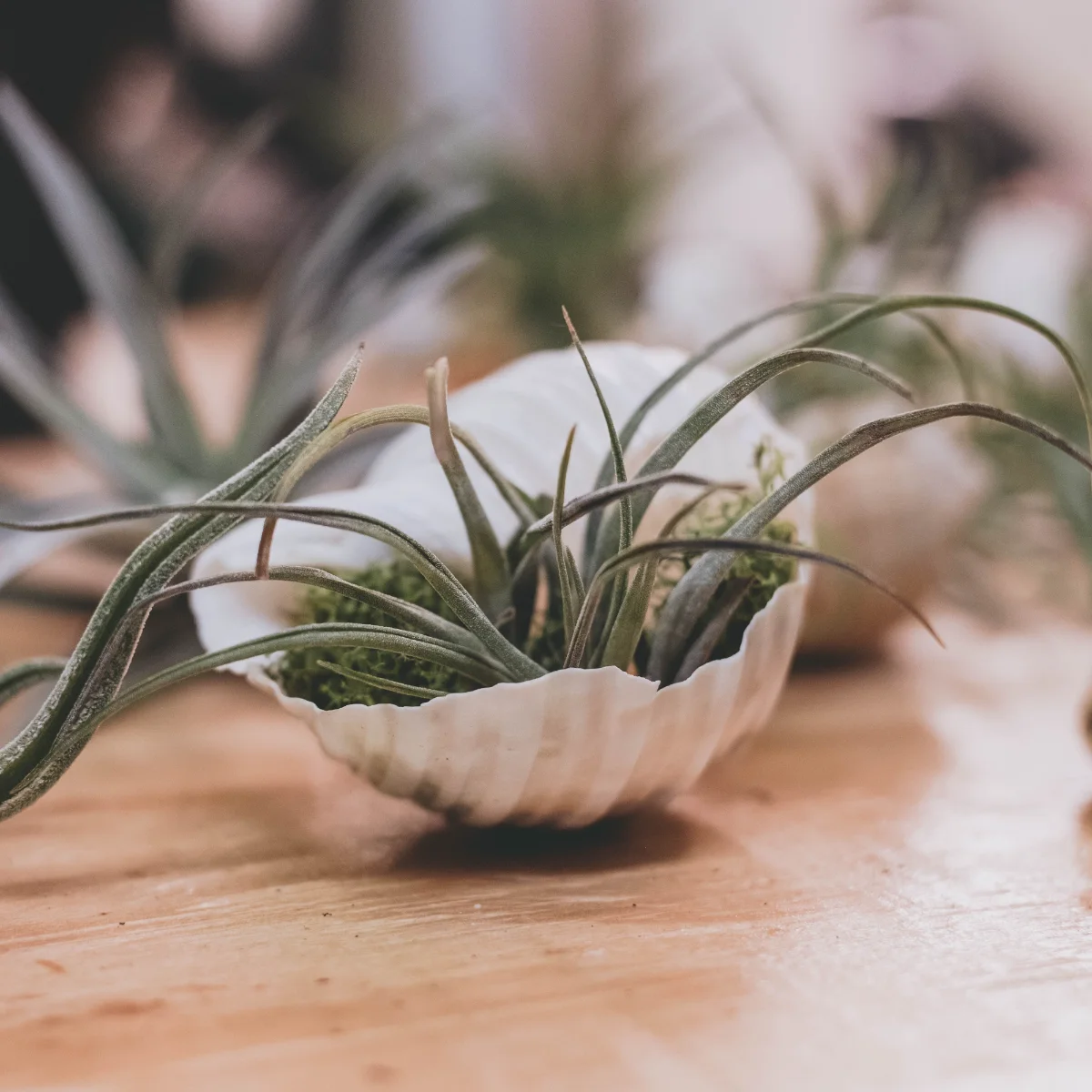
Air plants (Tillandsia) are epiphytes that grow without soil, absorbing water and nutrients through their leaves. They are some of the most flexible houseplants available: they mount on driftwood, rest in shells, hang in glass globes, or sit on a shelf with no pot required. With a weekly soak and bright indirect light, most species thrive for years and produce pups that expand into clusters.
Quick Care Reference
| Care Aspect | Requirement | Frequency |
|---|---|---|
| Watering | Soak weekly | Once or twice a week |
| Light | Bright indirect | Avoid intense afternoon direct sun |
| Humidity | 40-70% | Mist between soaks in dry climates |
| Fertilizer | Bromeliad or dilute balanced | Monthly (optional) |
| Repotting | No soil needed | Remount or rearrange as desired |
Watering
The primary method is soaking: submerge the entire plant in room-temperature water for 20 to 60 minutes once a week. After soaking, shake off excess water and place the plant upside-down on a towel in a bright area for 1 to 4 hours so it can dry completely. Standing water at the crown causes crown rot, which is fatal. In dry climates or during summer, soak twice weekly. In winter or humid climates, once a week is sufficient. Misting between soaks adds humidity but should not replace soaking.
Light Requirements
Air plants need bright indirect light to thrive. An east- or west-facing window is ideal. South-facing windows work well if the plant is set back from direct midday sun. North-facing windows are too dim for most species and will cause slow decline. Air plants grown under artificial light do well with full-spectrum LEDs placed 6 to 12 inches away for 12 hours a day.
Humidity & Temperature
Air plants prefer humidity between 40 and 70%. They adapt to average home humidity (40 to 50%) as long as soaking is regular. In very dry climates or during winter heating, soak more frequently and mist between soaks. Temperatures between 50 and 90°F (10 to 32°C) are suitable; avoid frost or prolonged cold below 45°F (7°C).
Fertilizing
Feed once a month by adding a small amount of bromeliad fertilizer or a balanced water-soluble fertilizer diluted to one-quarter strength to the soaking water. Fertilizing is optional but encourages faster growth and more robust blooming. Do not use fertilizers containing copper, which is toxic to Tillandsia.
Propagation
Air plants reproduce by producing offsets called pups at the base of the mother plant after she blooms. Pups can be separated or left to form a clump.
Pup separation
- Wait until the pup is at least one-third the size of the mother plant
- Gently twist the pup away from the mother with a slow side-to-side motion
- If it resists, use a clean knife to separate at the base
- Care for the pup identically to the mother: soak weekly, bright indirect light
- The mother plant will continue producing pups until she dies naturally
Popular Varieties
Tillandsia ionantha
One of the most common; compact, turns red-pink before blooming.
Tillandsia xerographica
Large, silvery rosette with curling leaves; dramatic display plant.
Tillandsia caput-medusae
Bulbous base with long twisting leaves; very tolerant of dry conditions.
Tillandsia stricta
Produces a showy pink bract with purple flowers; great for beginners.
Seasonal Care Calendar
Spring
Mar – May
- Resume weekly soaking as indoor air dries from heating. Watch for new growth.
- Fertilize monthly in soaking water. Bright indirect light supports active growth.
- Peak growing season. Soaking weekly is essential. Watch for emerging bloom stalks.
Summer
Jun – Aug
- In hot dry weather soak twice a week. Keep away from intense afternoon sun.
- Continue bi-weekly soaking if temperatures exceed 85°F (29°C). Mist on off days.
- Continue regular soaking. Pups may appear at the base after flowering.
Fall
Sep – Nov
- Return to weekly soaking as temperatures drop. Reduce fertilizing.
- Stop fertilizing. Continue weekly soaking.
- Move away from cold windows. Continue weekly soaking.
Winter
Dec – Feb
- Soak weekly. Keep away from cold drafts and heating vents.
- Continue weekly soaking. Ensure 4 hours of drying time after each soak.
- Maintain bright indirect light. Soak weekly and dry completely.
Troubleshooting
Brown or mushy base
Why it happens: Crown rot from standing water
What to do: Remove rotted tissue with clean scissors, let dry completely, and resume soaking with thorough drying afterward.
Ask the AI about this →Crispy brown leaf tips
Why it happens: Underwatering or low humidity
What to do: Increase soaking to twice weekly and mist between soaks. Move away from heating vents.
Learn more: Why Are My Plant Leaves Turning Brown → Ask the AI about this →Leaves curling inward
Why it happens: Underwatering
What to do: Soak for 60 minutes instead of 20, and increase frequency to twice a week.
Learn more: Why Are My Plant Leaves Curling → Ask the AI about this →Slow or no growth
Why it happens: Insufficient light or nutrients
What to do: Move to a brighter location and add dilute bromeliad fertilizer to monthly soaks.
Ask the AI about this →Not sure what's wrong?
Premium includes AI photo diagnosis, then walks you through the fix and checks back in until it's better.
See Premium →Track your Air Plant with PlantCareAI
Add your Air Plant and get a watering schedule tuned to this week's weather. Free for up to 3 plants.
Add your Air Plant